
The Founder And The Fisherman
You can grind your way to the top 10% of most fields. The top 0.1% works differently: it's reserved for people who've found the work so absorbing they've stopped noticing the grind at all.
— Adam Shuaib (@adamshuaib) May 10, 2026
Edison's assistants said he genuinely couldn't understand why his employees got tired.…
Himalayan Compute: 10 Years To A Trillion: Detailed Roadmap
Nepal's Trillion Dollar Himalayan Compute Plan 🏔️Himalayan Compute: Nepal’s Blueprint for Triple-Digit Economic Growth
Sameer Maskey: Why Nepal must build a sovereign ‘AI Factory’
बुढानीलकंठ स्कुल: स्याउ रुख बाट झर्यो, अंतरिक्ष तर्फ हाननियो
Himalayan Compute: The Vehicle For Nepal's Economic Revolution
अमेरिकामा रहेको प्रत्येक नेपालीको आर्थिक क्रांति गर्ने प्रथम र अंतिममौका
Nepal's Trillion Dollar Himalayan AI Moonshot
🇳🇵 The Super App That Will Transform Nepal
Most geniuses didn’t have exceptional mentors. In fact, history shows us that the protégés of outliers rarely became outliers themselves.
— Adam Shuaib (@adamshuaib) May 28, 2026
Da Vinci ran a large workshop in Milan and trained dozens of apprentices, none of whom broke out. At Los Alamos, Feynman had formed his…
— Adam Shuaib (@adamshuaib) May 27, 2026
The personality type that showed up most frequently in our research on true outlier founders wasn’t “leader” or “visionary”. It was “difficult”.
— Adam Shuaib (@adamshuaib) May 26, 2026
As children, we found most never did the group work activity in school. They were often the students who didn’t raise their hand in…
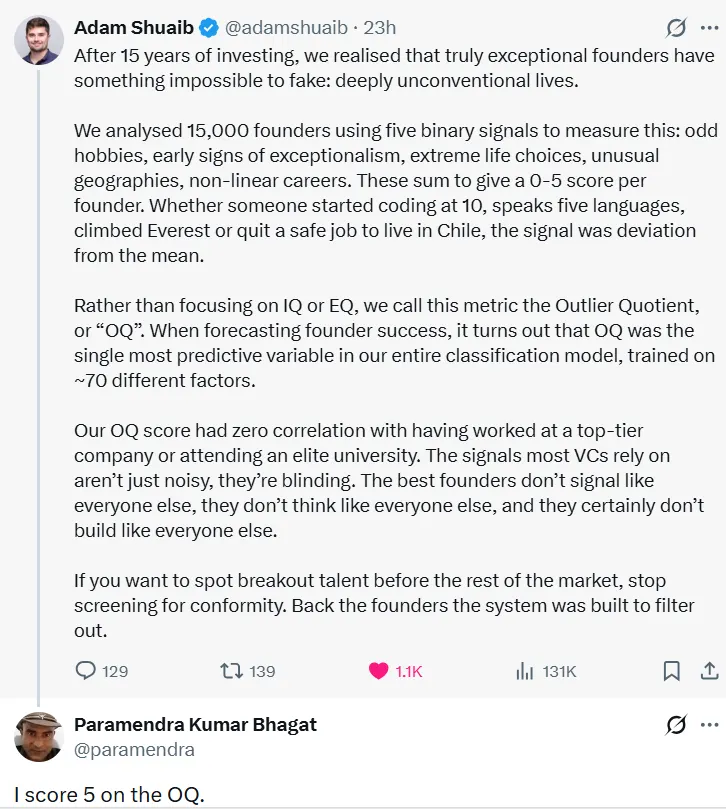
After 15 years of investing, we realised that truly exceptional founders have something impossible to fake: deeply unconventional lives.
— Adam Shuaib (@adamshuaib) May 24, 2026
We analysed 15,000 founders using five binary signals to measure this: odd hobbies, early signs of exceptionalism, extreme life choices,…
Across 5000+ founder meetings, the single rarest success trait we saw was pathological determination (<1% of founders). Having a good work ethic is not enough; these individuals possess a borderline-delusional ability to run through any wall they meet, and don’t have an off…
— Adam Shuaib (@adamshuaib) May 23, 2026
A significant portion of unicorn founders were rejected over 50 times before finding a VC willing to be anti-consensus. We met a unicorn founder who was turned down 100 times during their seed raise because the product sounded like science fiction and the team didn't fit the AI…
— Adam Shuaib (@adamshuaib) May 23, 2026
Most hyper-successful people have a weird relationship with money: they are simultaneously obsessed with it and completely uninterested in spending it.
— Adam Shuaib (@adamshuaib) May 21, 2026
Sam Walton drove the same beat-up pickup truck for decades while running the largest retailer on earth. Warren Buffett still…
One of the worst predictors of founder success we've tracked is how well someone pitches. The correlation between pitch quality and outcome was actually negative.
— Adam Shuaib (@adamshuaib) May 19, 2026
Zuckerberg was so awkward in early investor meetings that VCs left wondering if he could manage anyone. Larry Page…
One of the worst predictors of founder success we've tracked is how well someone pitches. The correlation between pitch quality and outcome was actually negative.
— Adam Shuaib (@adamshuaib) May 19, 2026
Zuckerberg was so awkward in early investor meetings that VCs left wondering if he could manage anyone. Larry Page…
The best curveball question we've added to founder meetings: "What did you do for fun as a kid?"
— Adam Shuaib (@adamshuaib) May 19, 2026
Great founders describe a solitary, often antisocial activity. Running an imaginary sports league with handwritten stats sheets, inventing card games no one would ever play, writing… pic.twitter.com/Rq4oI1LOQz
The most overlooked predictor of extraordinary work is a person's capacity to completely vanish when a problem requires it.
— Adam Shuaib (@adamshuaib) May 18, 2026
When Cambridge closed for the plague in 1665, Newton went home to a Lincolnshire farmhouse and saw no one for 18 months. In that single stretch of…
After 5,000 founder meetings, we discovered that many of the world’s greatest builders are blessed (and cursed) with a mind that is thinking 24/7.
— Adam Shuaib (@adamshuaib) May 17, 2026
There is no off switch.
Notebooks kept by the bed for ideas that arrive at 3am and won't survive until morning. Phones full of…
After 5,000 founder meetings, we discovered that many of the world’s greatest builders are blessed (and cursed) with a mind that is thinking 24/7.
— Adam Shuaib (@adamshuaib) May 17, 2026
There is no off switch.
Notebooks kept by the bed for ideas that arrive at 3am and won't survive until morning. Phones full of…
An underrated trait we see in brilliant minds is the ability to delete months or years of work without hesitation.
— Adam Shuaib (@adamshuaib) May 17, 2026
Hemingway cut 90% of what he wrote before publishing it. His novels read effortlessly because of what was taken out. James Dyson built 5,127 prototypes of his…
One quirky behaviour from our research on outlier talent: they talk out loud to themselves. A lot.
— Adam Shuaib (@adamshuaib) May 15, 2026
Muttering through problems in open-plan offices, pacing the hallway in conversation with no one. To most people you will look crazy.
Claude Shannon was known at Bell Labs for…
One unexpected pattern when studying the lives of generational talents: many were completely unremarkable in their 20s. The breakthrough came much later.
— Adam Shuaib (@adamshuaib) May 14, 2026
Edison was 32 before the phonograph. Curie was 36 when she isolated radium. Franklin was 40 before he turned to work on…
There is a strange pattern in the lives of outliers that contradicts how people perceive genius: 99% of projects they worked on were failures.
— Adam Shuaib (@adamshuaib) May 13, 2026
High volume is a big clue: hundreds of failed prototypes for every one product that worked. Notebooks full of dead-end theories…
— Adam Shuaib (@adamshuaib) May 12, 2026
One hallmark of world-class achievers was making life decisions in their teens that their parents were upset by or strongly opposed to.
— Adam Shuaib (@adamshuaib) May 10, 2026
Willingness to disappoint people whose approval you've spent your life calibrated to seek is one of the rarest psychological traits in…
The strongest predictor of who does extraordinary work isn't intelligence or ambition. It's whether they ever obsessed over something pointless. We've seen this across 5,000+ startup meetings, but the pattern shows up across scientists, writers, athletes and artists.
— Adam Shuaib (@adamshuaib) May 8, 2026
They'd…
Truly great founders are often so abnormally good at one specific thing that it makes every other deficiency irrelevant. They are the opposite of “well rounded”.
— Adam Shuaib (@adamshuaib) May 8, 2026
This lopsided profile makes them tricky to evaluate, because the standard framework for assessing founders is a…
Most unicorn founders have a specific event in their past that made starting their company feel non-optional. We call it the “point of origin”. It's also the thing 99% of VCs never bother to look for.
— Adam Shuaib (@adamshuaib) May 7, 2026
For some founders, they couldn’t bear the thought of letting someone down.…
We went through 25,000 emails over 12yrs and calculated the average email response times across 10,000 seed founders. The ones who went on to build big companies replied twice as fast as everyone else.
— Adam Shuaib (@adamshuaib) May 7, 2026
The gap was much bigger than we expected. It held across timezones, vintages…
Many of the best founders share a trait that traditional managers would see as a red flag: they have a very low need for social approval.
— Adam Shuaib (@adamshuaib) May 6, 2026
Most people are terrified of looking like a fool or bothering people, but great founders will send ten follow-up emails to a dream hire or…
The founders worth betting on were often terrible employees. Many clashed with previous managers, didn’t follow instructions and quickly realised they were more effective than their boss.
— Adam Shuaib (@adamshuaib) May 5, 2026
In the wrong environment these people are marginalised or ignored. It’s also why previous…
One of the biggest myths in VC is that billion-dollar companies are built by deeply experienced insiders. Among 1500 unicorn founders, 60% had no prior experience in the sector where they eventually built their company. Only 35% had a technical background.
— Adam Shuaib (@adamshuaib) May 4, 2026
50% held no postgrad…
One of the biggest myths in VC is that billion-dollar companies are built by deeply experienced insiders. Among 1500 unicorn founders, 60% had no prior experience in the sector where they eventually built their company. Only 35% had a technical background.
— Adam Shuaib (@adamshuaib) May 4, 2026
50% held no postgrad…
Our research showed that unicorn founders often spent their teenage years obsessed with a difficult craft like competitive gaming, a musical instrument or obscure solo sports.
— Adam Shuaib (@adamshuaib) May 4, 2026
Mastering a niche as a 15yo teaches someone just how much boring, repetitive work is required to stand…
— Adam Shuaib (@adamshuaib) April 28, 2026
The Outlier Quotient: How we spot generational talent After 15 years of seed investing, we realised that truly exceptional founders have something impossible to fake: deeply unconventional lives.
................. Firstly, genuine outliers make you uncomfortable in the first few minutes of meeting them. They are not rude, but there is an intensity to how they think and talk that sits outside the range of a normal professional conversation, and part of you registers it as mild fear. You get the sense that this person is wired tighter than most, almost to the point of seeming unhinged, but not so far that they stop listening or taking feedback. They are maniacal, but they are still in control; that combination is critical. .................. The second is obsession of a kind you do not see in any normal person. This is someone who, after a ten-hour day, opens their laptop at 10pm and reads EU payment regulations until 3am, and does this for years. The work is not something they do; it is the thing they cannot stop doing. Ask them what they would build if this idea fails and you get a blank stare. The company and the person are the same thing. There is no plan-B. ................ The third: they have something massive to prove and someone specific to prove it to. A teacher who told them they would not amount to much. A classmate, a coach, a boss, a rejection letter, a moment in a room where someone made it clear they did not belong. One founder we met keeps a framed letter from their sixth-grade teacher on the office wall, explaining why they would never amount to anything as an adult. ..................... The fourth is a history of hardship. Immigrant households, children raised by single parents, founders who grew up watching a sibling or a parent fall seriously ill. The hardship itself does not cause the success; it gives the founder a relationship with risk and discomfort that 99% of people cannot handle. By 30, if you've spent your whole life inside a safety net, you can describe the idea of betting the house in fluent sentences but your body will not let you do it.
Something in you will pull your hand back at the last moment. ................... The fifth is that they have, by most ordinary measures, incredibly quirky/unusual personalities. They hold eye contact for slightly too long or not at all. They use words no one else uses. They have hobbies you've never heard of. One founder we met refused to take live pitch meetings and instead sent a fifteen-minute video he recorded alone in his kitchen. Neurodivergence in some form shows up far more often in our winners than in the broader population. These founders can be difficult at times. They are not always people you would be best friends with. ........................ seven binary signals: odd hobbies, early signs of exceptionalism, extreme life choices, unusual geographies, non-linear careers. Whether someone started coding at 10, speaks five languages, climbed Everest or quit a safe job to live in Chile, the signal was deviation from the mean.
..................... Rather than focusing on IQ or EQ, we call this metric the Outlier Quotient, or “OQ”. When forecasting founder success, it turns out that OQ was the single most predictive variable in our entire classification model, trained on ~70 different factors. ................ Our OQ score had zero correlation with having worked at a top-tier company or attending an elite university. It took us years to accept this, because the conventional signals feel like they should work. A Harvard PhD, four years at Meta, a stint at a hot Series-B; these are facts you can put in an IC memo. The trouble is they describe a population of people who are good at navigating institutions, and being good at navigating institutions is often orthogonal to being able to build one. .................. The best founders are not institutional optimisers. Most of them spent their lives being inordinately incompatible with whichever institution they were stuck in. .............. The hard part isn't believing the data, it's acting on it. Every incentive in the venture industry pulls toward the legible founder. The legible founder is easier to underwrite, easier to defend in a partner meeting, easier to explain to LPs and easier to introduce to other portfolio companies. The illegible founder is more work in every direction. You have to spend longer with them to see what's there. You have to tolerate meetings that feel weird. You have to defend internally a person who doesn't look the way founders are supposed to look. ......... If you want to spot breakout talent before the rest of the market, stop screening for conformity. Start screening for the life that didn't fit. Back the founders the system was built to filter out.
So you found me. Now invest. https://t.co/DuZYXyGuwm
— Paramendra Kumar Bhagat (@paramendra) May 28, 2026
I took this video while descending from the summit of Mt Everest (8,848.86 m) and approaching Everest Base Camp on 22 May 2026. Crossing the Khumbu Icefall has always meant navigating collapsing seracs, shifting ladders, and deep crevasses, but now another danger is rapidly… pic.twitter.com/m5ZKsM32Nc
— Poornima Shrestha (@poornimashresth) May 28, 2026
Somebody called me a Third Culture Kid. TCK.
— Paramendra Kumar Bhagat (@paramendra) May 30, 2026
The Founder: Profile By Adam Shuaibhttps://t.co/DuZYXyGuwm
— Paramendra Kumar Bhagat (@paramendra) May 30, 2026

No comments:
Post a Comment