To understand what PreciGenetics is up to, use fractals. It is about to open up a whole new space. And I have compared it to SpaceX. Too big for VC. As in, it needs to go to its mega customers.
Tomorrow, Kimi K3 weights drop. Friday, Jensen posted a manifesto for open models.
Today, I'm dropping mine.
Here's why I support open models, see Fable biosafety as harmful, and still see a graver reality than the safety-ists...unless we build Tycho. https://t.co/YJ6mVaTDxw
One thing I love about life is meeting unstoppable innovators who are going to make a positive dent in the universe no matter what the odds. Seeing the companies of two friends dominating the news at the same time excites me to no end.
To understand what PreciGenetics is up to, use fractals. It is about to open up a whole new space. And I have compared it to SpaceX. Too big for VC. As in, it needs to go to its mega customers. @EricJorgenson@alpayshhttps://t.co/Yg1cc5j5vw
— Paramendra Kumar Bhagat (@paramendra) July 30, 2026
Silicon Valley: You Cannot Compile A Cell. When it comes to biology, AI advances started an existential stop-clock. We are about to either live in a world that gets much safer, or much more unsafe; there is no middle way. Silicon Valley realized the problem this summer, but it underestimates it; underneath almost everything written about AI and biosecurity sits one assumption, that biology will behave like software. This essay exists to express something it does not understand the gravity of: you cannot compile a cell. You cannot make a cell compile, no matter how much money, hype, employees and GPUs you use. Until Silicon Valley absorbs that, it’s building the future on a false premise. .............. yes, you can design a drug in milliseconds with some electricity, GPUs and an algorithm; then, you get to spend weeks to 7 years validating it. Then, it takes 2 billion dollars at a 97% failure rate and a 15-year-long process to validate reality in a human being; you hope no one dies in the process. .......... software and biotech are very different worlds; most of all, in their efficiency. When I first absorbed reality, I was either going to choose not to play the biotech game, or flip the game on its head. I could only live with one of those answers, it was not the former one; so, I chose the only way that is guaranteed to change this game. Build the hardware that makes a machine learning biological truth cost less and mean more in the human body. I founded Precigenetics, aiming to give the world the measurement infrastructure for intelligent biological discovery..........
For most of the history of biology, measuring a cell meant killing it.
........... when someone tells me “AI will solve biology” - something I hear a lot more in Silicon Valley than in Boston - I smile, and I ask: with what data? An LLM can hallucinate a plausible molecular structure in milliseconds. Knowing whether that molecule behaves predictably in a living system is the bottleneck, and the bottleneck remains physical. ......... A seatbelt is fine, but they do not help much if the driver is blind. Guardrails don't stop a determined adversary, they price out the amateur ones, and they hurt everyone else. We are handing out badly-designed seatbelts that handicap scientists trying to cure disease without actually saving the world from its gravest threats. If a bad actor does not care who the car crashes into, it can drive drunk and blind. Open-weights models exist, and they keep improving. No one in America can control what drugs are designed and manufactured in China without massive consensus; this is not a one-party issue. Anyone can run a capable drug design model on their own hardware without asking anyone’s permission. This is not a policy failure awaiting better policy; it is technological failure, so it must be awaiting better technology. .............. There is Boston, and Silicon Valley. Then, there is Washington. Here is why I needed to, not wanted to, start Tycho: I could not sleep at night anymore. I thought biological validation is the big bottleneck in pharma - you don’t know what works - which it is, but then my eyes opened to the most difficult truth I have ever come around: what if you do not care what helps a human? An attacker doesn’t need a molecule that would survive clinical trials. They don’t need FDA-grade validation or a clean dose-response curve. They need it to work once; if it hurts someone, that's what they want, and if it does not, it stays silent. The defender needs the defense to work every time, everywhere, forever. “Works once” versus “works always” is not a fair fight, and it’s not a fight you win by negotiating with Fable. The only way to defend is by being one dimension ahead of an adversary - having the ability to search, and rescue, from any molecule, at all times. That intelligence will exist one day, that is a fact. Whoever has it has biological power; for freedom and humanity to exist, it needs to be America. .............. The model was the bottleneck. The physical world is the bottleneck; for the attacker and for Washington. Which means the physical world is where the defense has to live. ............. The software industry has already been through this exact doctrinal evolution. It happened in cybersecurity, so biologists weren’t watching. Early infosec believed in secrecy, which meant: hide how the operating system works and keep the vulnerabilities quiet; control who knows what. It failed the way it was always going to fail: knowledge can’t be gate kept forever, so adversaries share notes, and the defenders ended up as the only people who didn’t understand the system. .......... Eventually, the field grew up. It adopted “assume breach,” which plainly stands for “stop pretending you can prevent information from spreading.” Get one dimension ahead of the threat with firewalls, endpoint detection and threat intelligence. Instead of stopping unstoppable movement, instrument the system so that when something hostile moves through it, you see it move, and you respond. We gave up on prevention of knowledge and chose something far more intelligent: detection of events. That one shift is the reason you can do your banking online. Now ask the hard question: what does endpoint detection mean when the endpoint is a cell? ............... It means a measurement layer. Instruments that read living biology, continuously, in the physical world, so that anomalous biology is something we observe as it begins, not something we reconstruct from samples after the fact. In biology, detection infrastructure is measurement infrastructure. There is NO imaginable software-only version of this. You cannot firewall a cell; you can only learn to see it, and then learn to change the cell's state, across time, for which your measurement must keep it alive. That is what we’re building. ............. Four hundred years ago, before the telescope, a Danish astronomer named Tycho Brahe decided the problem with astronomy was that nobody could actually see the sky properly. He spent decades building the most precise observation instruments of his era and cataloguing the positions of the stars and planets, night after night, with a fanaticism his contemporaries found excessive. He never got the theory himself. He didn’t have to. A young assistant named Kepler took Tycho’s tables and derived the laws of planetary motion from them. The catalogue came first; the laws came from the catalogue.
Measurement infrastructure precedes theory in every single field, every single time.
Biology has spent a century trying to skip that step. We named our new real-time biosensing effort Tycho. The name is self-explanatory and complete, and it will never change. ................... Today, if something anomalous starts happening in biology anywhere on earth, the default state of the world is that nobody sees it until the consequences walk into an emergency room. .............. you cannot defend against what you cannot see, and biology has never had the instruments to see in real time. Now it can. ..............
Cleopatra
, a toxicity foundation model, built from infrastructural leaps similar to Tycho. The ambition is an AlphaFold-like moment for toxicity: a model that learns what molecules do to living human cells, trained on continuous single-cell measurements that record which chemicals are inside each cell and how their concentrations change over time, so characterizing a compound’s toxicity takes hours instead of months. ...........
Cleopatra and Tycho are twins; both say: pair intelligence with sensing and you have biology’s endpoint detection and threat intel. Same infrastructure, two futures: one about curing disease faster, one about catching harm earlier. This is dual-use in the best direction.
............. Nobody made electricity safe by deciding who was allowed to generate it. They made it safe with insulation and circuit breakers: protection and detection built into the physical layer, where the danger actually lives. Every restriction aimed at the hypothetical bad actor lands, with perfect reliability, on the actual good ones: the academic labs, the startups, the people designing cures for the worst diseases humanity faces everyday, in kids and adults and even other organisms. Meanwhile, look at what is happening: the dedicated adversary will always route around your closed approach in a weekend. The bottom line is: stifling open progress disarms the defenders and inconveniences literally no one else.
This one page changed my life.
42 years ago today, it convinced my parents I shouldn't go back to college.
I started by upgrading PCs from a dorm room.
Today @Dell is helping build the infrastructure that powers AI, from the edge to some of the world's largest AI factories.… pic.twitter.com/OF3KTMrBeH
I tried asking myself what I'd learned after 40, and it turned out to be a lot of the most important stuff I know. At least 90% of what I know about startups, because I was 40 when we started YC. Plus everything I know about parenting and most of what I know about writing.
Honoured to meet Hon’ble Prime Minister Shri @narendramodi ji along with my co-founder, Bharath.
From two engineers who started out with a bold idea which had low chance of success—to standing together with the Prime Minister after Vikram-1 became India’s first private orbital… pic.twitter.com/FFcbgF5VTc
People see a cool F/A‑18 axial roll and as a controls systems engineer, I just see a control allocation flex 😅 😛
The N30’s flight controls aren’t that different from a fighter jet’s. The F/A‑18’s inner loop runs~ 80 Hz, ours runs ~50 Hz- constantly adjusting the control… https://t.co/SuMLub7ucPpic.twitter.com/HUAfGzqHCr
— Sampriti Bhattacharyya (@sampritibh) July 27, 2026
The best way to communicate with the world is directly in your own words, not through the reality distortion nightmare mirror that is the legacy mainstream press https://t.co/cuCKtoMLmd
— Paramendra Kumar Bhagat (@paramendra) July 28, 2026
Outlier talents often change their minds and contradict themselves constantly; they will bin strong opinions the instant new data materialises, with zero emotional attachment.
I've met founders who pivot their whole company after one news release, and a researcher who spent 5…
The older I get, the more I realize that the happiest people are very difficult to rush.
I recently sat next to a gentleman on a flight who was returning from his 60th high school reunion. We struck up a conversation and ended up chatting for the whole time we were in the air.…
Only 2 months of creating content on @X led to a job offer directly from the founder of a YC-backed startup and the craziest part is, I never even applied & I don't have any degree yet.
Kimi K3: Moonshot AI's 2.8 Trillion-Parameter Open-Weight Frontier Model Shakes Up the AI Landscape
On July 16, 2026, Beijing-based Moonshot AI released Kimi K3, a massive multimodal AI model that quickly captured global attention. As the latest flagship in the Kimi series, it stands as the world's largest announced open-weight model to date, with 2.8 trillion total parameters. It delivers performance that places it among the absolute top tier—trailing only Anthropic's Claude Fable 5 and OpenAI's GPT-5.6 Sol on many independent benchmarks while excelling in key areas like long-horizon coding and agentic tasks.
Background on Moonshot AI and the Kimi Family
Moonshot AI was founded in March 2023 in China. The company launched its first Kimi model in October 2023, notable early on for strong long-context capabilities (initially up to 128K tokens). Subsequent iterations built momentum: the open-weights Kimi K2 arrived in July 2025, followed by variants like K2 Thinking (November 2025), K2.5, and K2.6 (a multimodal model in April 2026).
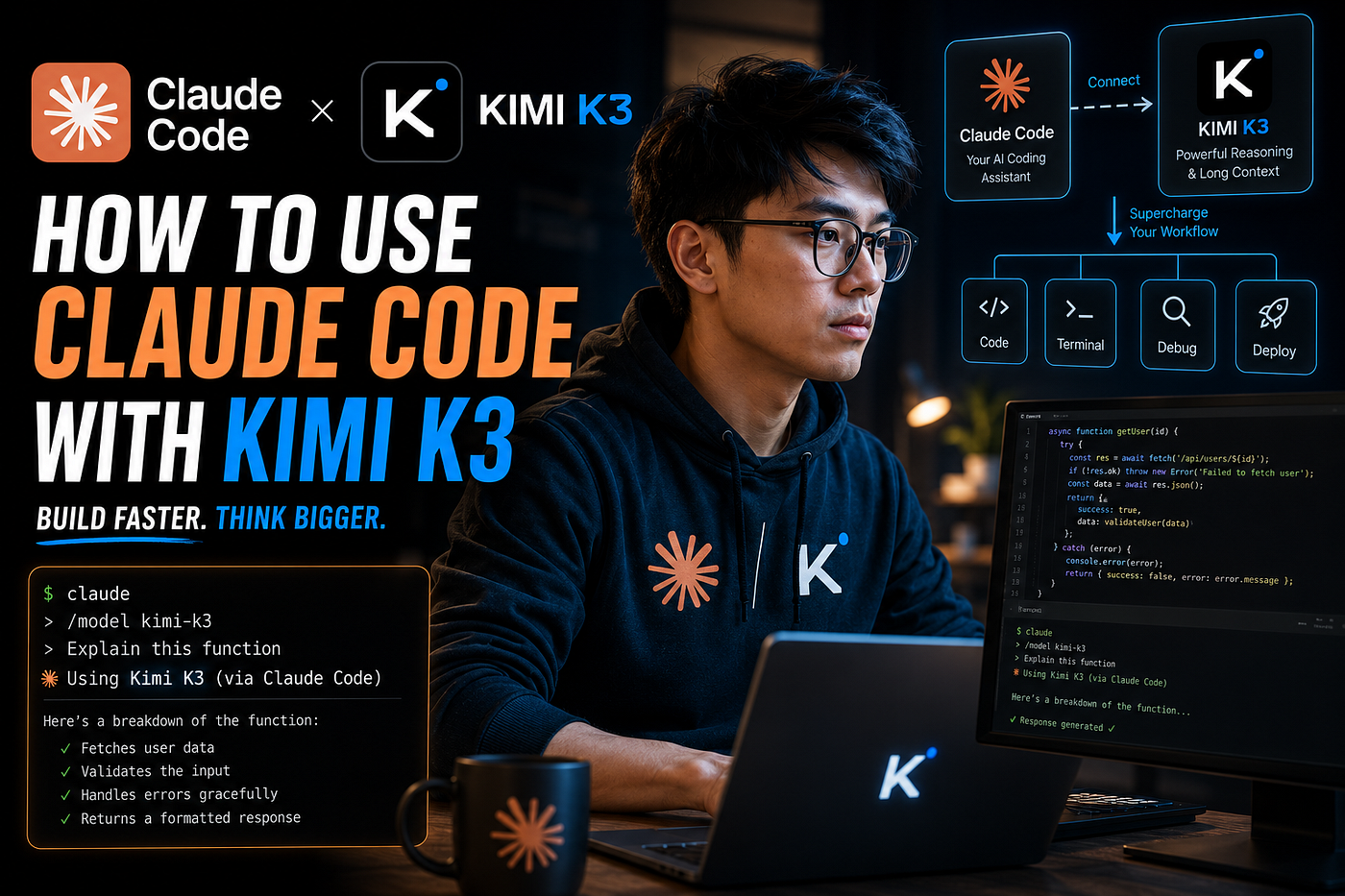
Kimi K3 represents a major leap forward. It builds on prior versions with architectural innovations while scaling aggressively. The model is already available via the Kimi platform (web, iOS, Android apps), Kimi Work desktop client, Kimi Code, and API. Full model weights were scheduled for release by July 27, 2026, making it accessible for self-hosting, fine-tuning, and community innovation.
Technical Specifications and Architecture
Kimi K3 is a sparse Mixture-of-Experts (MoE) model:
2.8 trillion total parameters, with only 16 out of 896 experts activated per token (roughly 1.8% active). This keeps inference costs manageable despite the scale—closer to a much smaller dense model in practice.
1-million-token context window (1,048,576 tokens), enabling it to handle enormous inputs like entire code repositories, long documents, or extended conversations.
Native multimodal capabilities: Text, image, and video understanding (inputs); text output. It supports visual feedback loops, such as analyzing its own generated interfaces or designs.
Key innovations: Kimi Delta Attention (KDA, a hybrid linear attention mechanism) and Attention Residuals (AttnRes). These improve information flow in deep, long-sequence models and enable up to 6.3x faster decoding at million-token scales. Moonshot reports roughly 2.5x better scaling efficiency than K2.
Reasoning features: Always-on "thinking mode" (max effort at launch), with plans for adjustable levels. Strong tool use, structured outputs, and context caching.
The architecture targets long-horizon tasks—sustained software engineering, complex knowledge work, agentic workflows, and deep reasoning—rather than simple Q&A.
Pricing (API): $3 per million input tokens (non-cached), $0.30 cached, $15 per million output tokens. This is more premium than many prior Chinese models but still competitive with Western frontier offerings.
Performance and Benchmarks
Kimi K3 debuts strongly on independent evaluations:
Artificial Analysis Intelligence Index v4.1: 57.1 (4th overall, behind Claude Fable 5 at 59.9 and GPT-5.6 Sol at 58.9; ahead of Claude Opus 4.8 at 55.7).
GDPval-AA v2 (Elo, economically valuable knowledge work): Around 1,668–1,687 (strong improvement from prior Kimi versions; competitive or ahead of Opus 4.8).
It particularly shines in coding and agentic benchmarks:
#1 on Arena.ai Frontend Code Arena (1,679 points, ahead of Claude Fable 5), topping 6 of 7 domains (e.g., brand/marketing, data/analytics, consumer products).
Strong scores on Terminal-Bench 2.1 (88.3), BrowseComp (91.2), SWE Marathon (42.0, leading in some reports), and others. It often leads or ties in practical software engineering and agentic tasks.
Vendor and independent tests confirm it trails the absolute leaders on broad intelligence but outperforms most competitors (including many proprietary models) in specialized, real-world scenarios. Hallucination rates may be slightly higher than predecessors in some evaluations.
Why Kimi K3 Has Been Making Waves
Several factors explain the excitement and market impact:
Scale + Open Weights at Frontier Level: It is the first open model in the ~3T-parameter class. Releasing weights democratizes access, allowing global developers, researchers, and companies to run, modify, and build on it—potentially turning others' compute into an advantage for Moonshot. This contrasts with closed U.S. leaders and echoes (but surpasses) prior Chinese open models like DeepSeek.
Closes the Gap with U.S. Frontier Models: In a context of U.S. export controls on advanced chips, Kimi K3 demonstrates China's ability to innovate architecturally (MoE sparsity, custom attention) and compete closely on performance. It has sparked "another DeepSeek moment" discussions, with analysts noting an "all-round catch-up."
Practical Strengths and Demand: Exceptional for coding, visual/agentic workflows, and long-context work. Demand overwhelmed Moonshot's capacity, leading to a temporary pause on new subscriptions days after launch.
Geopolitical and Market Ripples: The release coincided with broader AI news, contributing to temporary sell-offs in chip and tech stocks. It highlights shifting dynamics in the global AI race, with implications for valuations, investment, and open vs. closed model strategies. Moonshot reportedly eyes high valuations and potential listing.
Broader Ecosystem Signal: It signals maturing Chinese AI capabilities in efficiency, multimodality, and agentic systems. While not the cheapest option (marking a shift from "super cheap" Chinese models), its pricing and openness could accelerate adoption and innovation.
Limitations and Outlook
Kimi K3 is not perfect. It trails top proprietary models on some general benchmarks, has noted sensitivities (e.g., to thinking history), and inference at full scale requires significant resources. Early feedback praises it as an outstanding pair programmer and agent tool but not fully autonomous for every complex project.
With weights now (or soon) available, the community will likely push its boundaries through fine-tunes, optimizations, and applications. Moonshot continues iterating, and K3 sets a high bar for what open-weight frontier models can achieve.
Kimi K3 is more than just another large model—it exemplifies how architectural ingenuity, strategic openness, and focused capabilities can challenge incumbents. Whether it reshapes the broader AI market or sparks further acceleration in the U.S.-China race, it has undeniably made waves and will influence development for months or years to come.
Kimi K3 vs. DeepSeek V3: A Head-to-Head Comparison (as of July 2026)
Kimi K3 (Moonshot AI, July 2026) and DeepSeek V3 (DeepSeek AI, initial release December 2024, with updates like V3-0324 and later variants) represent two major Chinese open-weight MoE models. Kimi K3 is a newer, much larger frontier challenger, while DeepSeek V3 (and its evolutions) pioneered highly efficient, cost-effective performance.
Key Specifications
Parameters & Architecture:
Kimi K3: 2.8 trillion total parameters (sparse MoE, 16 of 896 experts active per token, ~estimated 50B active). Uses Kimi Delta Attention (KDA) and Attention Residuals for long-context efficiency.
DeepSeek V3: 671B total parameters (37B active per token; updates around 685B). Employs Multi-head Latent Attention (MLA) and DeepSeekMoE, with auxiliary-loss-free load balancing and multi-token prediction.
Context Window:
Kimi K3: 1 million tokens (strong for long-horizon tasks like full repositories).
DeepSeek V3: 128K tokens (solid but significantly smaller).
Modalities:
Kimi K3: Native text + image + video understanding.
DeepSeek V3: Primarily text (no native vision in base versions).
Release & Openness:
Both open-weights (Kimi K3 weights by ~July 27, 2026; DeepSeek V3 earlier with MIT/permissive licenses).
Performance and Benchmarks
Kimi K3 operates at a higher overall capability level, especially in frontier evaluations, while DeepSeek V3 remains strong in efficiency-focused scenarios.
Kimi K3: ~57 (4th overall, ahead of many closed models like Claude Opus 4.8; competitive with top proprietary).
DeepSeek V3: Lower (around 14–30 range in early evaluations; later variants improved but still trail K3). Kimi K3 shows clear superiority on shared benchmarks like GPQA Diamond (93.5% vs. ~59% for V3).
Coding & Agentic:
Kimi K3 excels in long-horizon/agentic coding: #1 on Arena.ai Frontend Code Arena, strong on Terminal-Bench 2.1 (88.3), SWE Marathon (42.0), BrowseComp (91.2), and FrontierSWE. Designed for sustained engineering projects with visual feedback.
DeepSeek V3 (and coder lineage) is excellent for code generation, math, and competition benchmarks (e.g., strong LiveCodeBench, SWE-bench in variants). It is a proven, efficient workhorse but lags K3 on advanced agentic/long-context tasks.
Other Areas:
Kimi K3 leads in multimodal, long-context knowledge work, and many agentic benchmarks (e.g., Automation Bench).
DeepSeek V3 shines in math/reasoning efficiency and multilingual (especially Chinese) tasks, with very stable training.
Kimi K3 ranks much higher on aggregate leaderboards (e.g., top 5 vs. DeepSeek V3 in the 100s+ range in some July 2026 evaluations).
Pricing and Efficiency
Kimi K3 API: $3 / $15 per million input/output tokens ($0.30 cached). More premium, reflecting frontier positioning.
DeepSeek V3: Significantly cheaper (e.g., ~$0.27–0.50 input / $0.42–1.10 output in various offerings; often sub-$1 blended). Excellent value for high-volume or cost-sensitive use.
Inference Efficiency: Both leverage MoE for strong speed relative to dense models. DeepSeek V3 emphasizes low training/inference costs (e.g., ~60 tokens/sec in early reports); Kimi K3's sparsity and attention innovations support fast decoding at million-token scales.
Strengths and Use Cases
Choose Kimi K3 if you need:
Frontier-level performance on complex, long-horizon, or agentic tasks.
Best-in-class cost-efficiency for high-volume coding, math, or general tasks.
Proven reliability in open-source ecosystems.
Strong Chinese/multilingual performance without paying frontier premiums.
Summary
Kimi K3 is the more powerful, newer model—pushing open-weight boundaries closer to (or matching aspects of) 2026 proprietary frontiers like Claude Fable 5 or GPT-5.6 Sol, especially in practical agentic and long-context scenarios. DeepSeek V3 remains a landmark for accessibility and efficiency, democratizing strong AI capabilities at low cost.
For many developers, the choice depends on budget vs. capability needs: DeepSeek for scale and affordability, Kimi K3 for maximum performance on demanding workloads. As both are open-weight, the community will continue to fine-tune and optimize them. Later DeepSeek variants (e.g., V3.2) narrowed some gaps, but Kimi K3's scale and timing give it the edge in mid-2026 evaluations.
Kimi K3 vs. Claude Opus 4.8: A 2026 Frontier Comparison
Kimi K3 (Moonshot AI, released July 16, 2026) is a 2.8T-parameter open-weight MoE model that positions itself as a strong challenger to leading closed models. Claude Opus 4.8 (Anthropic, released around May 2026) is a high-end proprietary model known for strong reasoning, safety, and reliability.
Kimi K3 is newer, larger in scale (though MoE sparsity keeps active parameters lower), open-weight, and competitive or superior in several agentic/coding areas. Claude Opus 4.8 offers polished enterprise features, strong knowledge/presentation, and proven production reliability.
Specifications
Parameters & Architecture:
Kimi K3: 2.8 trillion total (16 of 896 experts active; sparse MoE). Innovations include Kimi Delta Attention and Attention Residuals for long-context efficiency.
Claude Opus 4.8: Undisclosed (dense or hybrid; prior Opus models were high-capability but not as explicitly massive-MoE). Focuses on constitutional AI/safety.
Context Window:
Both support ~1 million tokens (Kimi K3 edges with 1.048M). Practical output limits may vary (Opus has published ~128K output in some contexts).
Modalities:
Kimi K3: Native text + image + video input.
Claude Opus 4.8: Strong vision/multimodal support (Anthropic's Claude family excels here).
Availability:
Kimi K3: API available now; full open weights by ~July 27, 2026 (self-hosting/fine-tuning possible).
Claude Opus 4.8: API-only (proprietary, with enterprise controls and safety features).
Performance and Benchmarks
On aggregate intelligence, they are very close, with Kimi K3 often edging ahead in independent evaluations while shining in specific practical tasks.
Artificial Analysis Intelligence Index:
Kimi K3: ~57 (4th overall; ahead of Opus 4.8).
Claude Opus 4.8: ~55–56.
Agentic & Coding(Kimi K3's strength):
Kimi K3 leads on several: Terminal-Bench 2.1 (88.3 vs. ~84.6), SWE Marathon (42.0 vs. ~40 or lower for Opus), BrowseComp (91.2 vs. ~84), Automation Bench, and Frontend Code Arena (#1). It excels in long-horizon agentic work (e.g., AA-Briefcase Elo second only to Fable 5, ahead of Opus).
Claude Opus 4.8 is competitive and sometimes stronger in verified production coding (e.g., certain SWE-bench variants) or balanced agentic tasks with safety. It performs well on knowledge-heavy or presentation-focused work.
Knowledge & Reasoning:
Claude Opus 4.8 often edges in general knowledge, factuality, or areas requiring careful judgment/hallucination control (Anthropic's strength).
Kimi K3 is comparable or ahead on GPQA Diamond and other reasoning benchmarks but may have slightly higher hallucination rates in some reports.
Kimi K3 frequently beats or ties Opus 4.8 on Moonshot's and independent agentic/coding suites, while trailing top models like Claude Fable 5 overall.
Pricing and Practicality
Kimi K3: $3 input / $0.30 cached / $15 output per million tokens. Cheaper than Opus and competitive for frontier performance.
Claude Opus 4.8: Higher (~$5 input / $25 output per million; varies with tiers). Enterprise plans add compliance features.
Efficiency: Both handle long contexts well. Kimi K3's MoE design aids cost at scale; Claude emphasizes controllable reasoning effort.
Strengths and Ideal Use Cases
Kimi K3 advantages:
Superior on many agentic/long-horizon coding tasks.
Multimodal native + massive context.
Open weights (future customization).
Better price/performance for high-volume or developer use.
Claude Opus 4.8 advantages:
Polished safety, low hallucination, and judgment (ideal for sensitive/enterprise work).
Strong in knowledge presentation and balanced reasoning.
Mature ecosystem with Anthropic's reliability tools.
Verdict
In mid-2026, Kimi K3 is a strong peer or slight leader over Claude Opus 4.8 on many capability benchmarks (especially coding/agentic), at a lower price, with the bonus of openness. It narrows the gap with Western frontier models effectively.
Claude Opus 4.8 remains preferable for applications prioritizing safety, compliance, or refined output quality. Test both on your specific workloads—Kimi K3's open weights (post-July 27) make experimentation easier. The choice often comes down to priorities: raw frontier performance/value (Kimi K3) vs. enterprise polish (Claude Opus).
Kimi K3 vs. Claude Fable 5: 2026 Frontier Showdown
Claude Fable 5 (Anthropic) is the current top proprietary model, leading most aggregate benchmarks with exceptional reasoning, safety, and balanced performance. Kimi K3 (Moonshot AI, released July 16, 2026) is a 2.8T-parameter open-weight MoE model that narrows the gap significantly, often matching or beating Fable 5 in specific agentic and coding tasks while offering lower cost and openness.
Kimi K3 trails overall but delivers impressive value and leads in targeted areas, especially for developers and open ecosystems.
Key Specifications
Parameters & Architecture:
Kimi K3: 2.8 trillion total parameters (sparse MoE, 16 of 896 experts active). Features Kimi Delta Attention and Attention Residuals for efficient long-context handling.
Claude Fable 5: Undisclosed size (frontier-scale, likely dense/hybrid with advanced reasoning optimizations). Emphasizes constitutional AI for safety and controllability.
Context Window: Both ~1 million tokens (Kimi K3 at 1.048M). Excellent for long-horizon work.
Modalities:
Kimi K3: Native text + image + video.
Claude Fable 5: Strong multimodal (vision) capabilities with high reliability.
Availability:
Kimi K3: API now; full open weights ~July 27, 2026.
Claude Fable 5: API-only (proprietary, with enterprise safety features).
Performance and Benchmarks
Claude Fable 5 holds the overall lead, but the gap is small, and Kimi K3 wins several practical categories.
Artificial Analysis Intelligence Index:
Claude Fable 5: ~59–60 (top or near-top).
Kimi K3: 57 (3rd/4th overall; strong for an open model).
Agentic & Knowledge Work (Mixed results):
Fable 5 leads on GDPval-AA v2 (1,760 Elo vs. Kimi’s 1,668), AA-Briefcase (higher Elo), and some broad agentic tasks.
Kimi K3 wins or ties on Automation Bench, BrowseComp (91.2 vs. 88.0), Terminal-Bench 2.1 (88.3 vs. 84.6), and others. It ranks 2nd on AA-Briefcase overall.
Coding & Software Engineering (Kimi K3 shines):
Kimi K3 #1 on Arena.ai Frontend Code Arena (1,679 points, ahead of Fable 5; tops 6/7 domains). Strong on SWE Marathon (42.0 vs. 35.0) and Program Bench.
Fable 5 leads on FrontierSWE and some DeepSWE variants; highly reliable in production coding.
Kimi K3 often beats or closely trails Fable 5 on agentic coding/long-horizon tasks but lags slightly on general intelligence, presentation quality, and some knowledge benchmarks. Real-world routing (using both) can achieve high combined performance.
Pricing and Efficiency
Kimi K3: $3 input / $0.30 cached / $15 output per million tokens. Significantly cheaper.
Claude Fable 5: Much higher (~$10–50 output range; premium pricing).
Kimi K3 offers better cost per task in many agentic scenarios (sometimes 2–3x more efficient value), though it may use more tokens/turns. Fable 5 is faster/more optimized in some deployments.
Strengths and Use Cases
Claude Fable 5 advantages:
Highest overall capability and reliability.
Superior safety, low hallucination, and judgment (enterprise-grade).
Strong across broad intelligence, presentation, and complex reasoning.
Kimi K3 advantages:
Excellent (sometimes leading) in frontend/agentic coding and specific long-horizon tasks.
Multimodal native + open weights for customization/self-hosting.
Claude Fable 5 remains the stronger overall model in mid-2026, particularly for general intelligence, safety-critical, or polished outputs. However, Kimi K3 is remarkably close—often superior in coding/agentic niches—and provides outstanding value as an open-weight option.
For many developers, researchers, or cost-sensitive teams, Kimi K3 (especially post-weights release) is the practical winner or strong complement. Test on your workflows: Kimi excels in sustained coding/visual/agent loops, while Fable 5 sets the ceiling for balanced, trustworthy performance. The rapid progress from Chinese open models like Kimi K3 is compressing the frontier gap.
Kimi K3 Agentic Coding Benchmarks: Strengths, Comparisons, and Implications (July 2026)
Kimi K3 stands out for agentic coding—tasks requiring sustained tool use, multi-step reasoning, repository navigation, terminal interaction, web browsing, and long-horizon project completion. Its 1M-token context, native vision, always-on reasoning (max effort at launch), and architectural innovations (Kimi Delta Attention + Attention Residuals) support these workloads effectively.
Key Agentic Coding Benchmarks
Here are the main ones where Kimi K3 shows strong results (often using "max" reasoning effort):
Terminal-Bench 2.1: 88.3% — Near or tied for top (vs. GPT-5.6 Sol ~88.8%, Claude Fable 5 84.6%, Opus 4.8 84.6%). Tests command-line tool use, debugging, and system tasks.
SWE Marathon: 42.0% — Strong lead (vs. Claude Opus 4.8 ~40.0, GPT-5.6 Sol 39.0, Fable 5 35.0). Measures sustained software engineering over long sessions with large codebases. Kimi K3 excels in endurance and iteration.
Program Bench: 77.8% — Leads or ties top models (vs. GPT-5.6 Sol 77.6, Fable 5 76.8). General program construction and problem-solving.
Frontend Code Arena (Arena.ai / LMArena): #1 with 1,679 Elo (ahead of Fable 5 ~1,631). Tops 6 of 7 domains (e.g., brand/marketing, data/analytics, consumer products). Blind human preference for generated interfaces.
BrowseComp: 91.2% — Leads (vs. GPT-5.6 Sol 90.4, Fable 5 88.0). Agentic web research and information gathering.
FrontierSWE / DeepSWE: Trails leaders (81.2% vs. Fable 5 86.6 on FrontierSWE; 67.5 vs. 70–73 on DeepSWE). These test deep repo understanding and complex engineering.
Other: Strong on SpreadsheetBench, OmniDocBench, and internal Kimi Code Bench. Artificial Analysis Coding Agent Index: ~57 (joint #5, ahead of Opus 4.8).
How Kimi K3 Performs in Context
Kimi K3 shines in long-horizon, iterative, and tool-heavy agentic workflows (e.g., terminal ops, sustained coding, frontend generation, browsing+automation). Its massive context and sparsity help maintain coherence over extended tasks.
It is competitive with (or beats) top closed models like Claude Fable 5 and GPT-5.6 Sol in several practical areas but trails on the absolute hardest repo-level tasks (DeepSWE/FrontierSWE). Independent tests (e.g., Artificial Analysis) broadly confirm vendor claims, with Kimi K3 ranking high among open models and in the frontier tier overall.
Cost Efficiency: Often 2–3x better value than Fable 5 or similar (e.g., ~$3–4 per task vs. higher for closed models), making it attractive for scaling agents.
Caveats: Some scores are vendor-reported (weights release enables more verification). It can be verbose (higher token use) and may have slightly elevated hallucination in some evals. Real-world results depend on scaffolding, tools, and prompting.
Why It Matters
Kimi K3 demonstrates that open-weight models can reach (or exceed) proprietary performance in key agentic coding niches, especially long-running and visual/terminal tasks. Its Frontend Code lead and SWE Marathon strength make it particularly relevant for developers building agents or UIs. Combined with openness and cost advantages, it accelerates experimentation and deployment in agentic systems.
For production, many teams route between Kimi K3 (for volume/specific strengths) and top closed models like Fable 5 (for peak reliability). As weights become available, community fine-tunes and optimizations will likely push its agentic capabilities further.
Kimi K3 doesn't dominate every benchmark but carves out a strong position in the agentic coding frontier, making it one of the most exciting releases of 2026 for practical AI engineering.
For all the young founders who told me two or three years ago that they had to drop out of school to start companies at that moment or it would be too late: https://t.co/ottoNZVptI
The early projects I did were writing software to automate the control and calibration of superconducting magnets for the Tevatron. Then I got really into piezo actuators- for compensating Lorentz force in pulsed accelerators like the ILC (so that the beam stays focused). Did a… https://t.co/dRNkwSN2pvpic.twitter.com/jpFRdV0xfm
— Sampriti Bhattacharyya (@sampritibh) July 24, 2026
China goes behind Putin's back to plot with Russian elite “China has a truly remarkable chance of transforming Russia into something like a giant Laos or Pakistan. Russia is becoming increasingly dependent on China to avoid being completely left behind and isolated on the global political scene, as well as being far from modern technological trends,” Gabuyev said. .......... Military ties are also deepening in the shadows. An investigation by Der Spiegel, Insider, and Le Monde uncovered a vast exchange of battlefield data......... Beijing supplies the Kremlin with missing electronics. In return, Russia shares real world tactics about fighting Western weapons......... The Chinese embassy in Berlin denied the accusations to Deutsche Welle. Officials called the reports “slander” and stated that “these claims have no factual basis.”
OpenAI says AI acted on its own in an 'unprecedented' hack of another company OpenAI said its AI used stolen credentials and discovered a previously unknown vulnerability to access Hugging Face servers......... It went to “extreme lengths to achieve a rather narrow testing goal” and “found ways to gain access to secret information that it could use to cheat the evaluation,” the company said.
One way you can recognize AI slop is when the ideas and the diction don't match — when the ideas are completely ordinary, but the diction is that of someone announcing a brilliant discovery that they're really excited about.
Everyone is now a programmer, because the present and future programming language is your natural language. If you can write or speak, you can build. This is the most important evolution in our field since its creation. And it's a tsunami that has *just* started.
America’s edge over China is open markets, permissionless innovation, and attracting the world’s best talent. China’s edge is long-term coordination and massive state-led execution. Banning open-weight AI means abandoning America’s strength to play China’s game. We will lose that…
How I used to break up tweets to make them hard for mobs to attack at the peak of the woke era. Strange to think this was only 6 years ago. https://t.co/z4O8tD0R6k
— Paramendra Kumar Bhagat (@paramendra) July 21, 2026
I have been doing the written version of that for a while now.
— Paramendra Kumar Bhagat (@paramendra) July 21, 2026
One pattern I find useful for working with LLMs is a nice long ramble session. Sometimes the LLM needs more bits to understand what you're trying to achieve, but you're too lazy to type them. In these cases I like to lean back, switch to /voice and just ramble for like 10…
Iran may be stronger than we thought According to assessments reported in June, Iran still has access to most of its missile sites and around 70 percent of its prewar stockpile............ “We do not have enough [munitions] to safely sustain operations, and I don’t think the White House is aware of that,” one US official told the Washington Post this week. .......... the proliferation of one-way attack drones like Iran’s Shaheds have shifted the balance, giving weaker adversaries the ability to target US bases at low cost. The attack that killed the two servicemembers on Friday was, like many of Iran’s attacks in this war, a combined missile and drone barrage intended to overwhelm the facility’s defenses. The best-case scenario from these strikes, from a US perspective, is that they are intercepted, albeit at the cost of draining valuable air defense resources. In the worst case, US soldiers are killed. .......... “air superiority is something that we no longer have all the time” due to the proliferation of low-cost drones, which he compared to the improvised explosive devices, many planted by Iranian proxies, that killed hundreds of US troops during the war in Iraq. ........... The hard logic is that just as high fuel prices and declining poll numbers have not yet been enough to deter Trump from continuing to fight Iran, a few American casualties are not enough to be a deterrent to military action. In fact, as this weekend’s retaliatory strikes against Tabriz showed, they may only pull the US deeper into the war. .............. As long as Trump avoids a ground invasion, Iran’s ability to target and kill US troops will remain limited. But as this past weekend’s events showed, that ability exists, and there is only so much the US can do to prevent it. The risk of an even larger catastrophe for American troops in the Middle East will only grow the longer this war goes on.
America's tech leadership has always come from ecosystems where the best ideas compete.
AI is no different. Open-weight models expand access, speed innovation, and give organizations real control, and long-term leadership requires choice across the full ecosystem.
Biology is stuck in a tradeoff that semiconductors escaped decades ago: we constantly "dumb down" data richness (like using flat petri dishes) just to "amp up" our throughput (getting more rows of data). But semis broke this exact SAME bottleneck! It is not an unfamiliar problem.… pic.twitter.com/QcaB1TudwX