


Shyam Sankar https://t.co/buOYNRmNnU @ssankar
— Paramendra Kumar Bhagat (@paramendra) May 17, 2026
World War III Is Unnecessary https://t.co/VO6miTi6Ec
— Paramendra Kumar Bhagat (@paramendra) May 17, 2026
I talked about Mythos in my novel last year:https://t.co/Hjb8mNpLty The Great Subcontinent Uprising (Part 1) (novel)https://t.co/E5XjsDnZft The Great Subcontinent Uprising (Part 2) (novel)
— Paramendra Kumar Bhagat (@paramendra) May 17, 2026
The Patriot For two decades, Shyam Sankar has been the most important but hidden figure behind Palantir. The question now is whether he will win his wars. .......... Shyam Sankar ......... when people still refer to themselves, with a straight face, as members of “the conservative movement.” ............. the presentation of the 2025 Herman Kahn Award to Alex Karp. .......... There is also Nikki Haley, still radiant, like a star that shines brightly on Earth long after it has ceased to exist. ............. The previous year’s Herman Kahn Award was given to Mitch McConnell. ............... On the night of the 2025 Herman Kahn Award, after all, Palantir’s market cap was still approaching half a trillion dollars. ................ to the national-security-minded Hudson crowd, their Herman Kahn Award winner was still every bit at the spearhead of “defense tech.” ......... Most of the founders of Anduril, for example, cut their teeth working at Palantir, and several more alumni have gone on to found and staff much of the frontier defense technology ecosystem. ............ its openly ideological posture about defending “Western civilization” and “American greatness” ............ Between its work with the military and intelligence agencies; its openly ideological posture about defending “Western civilization” and “American greatness”; and the legions of fanboys that patrol the discourse around its eccentric leadership (which includes the company’s founder and chairman, Peter Thiel), Palantir in a room like this one is loved and feared, seen as both omnipotent and forbidden, mysterious but profound. ................. Its powerful software is said to have been used in the Bin Laden raid, in the strikes on Iran’s nuclear facilities, in America’s ICE raids, in the capture of Nicolás Maduro, and to stop countless attempted terror attacks that, for all you know, might have killed you and your family. ...................... the subject of so many chin-stroking think pieces on the ethical implications of its software .................... and why anyone should associate technology as mind-numbingly dull as “data integration and visualization” with either violations of the U.S. Constitution or of saving Western civilization. .................. The mononymous Shyam (pronounced Shahm, rhymes with “bomb”) is 43, 15 years younger than Karp, but has been with the company nearly as long. In March 2006, at the age of 24, he became the company’s 13th employee and never left. Grabbing the microphone in the Grand Ballroom, he appears cherubic and guileless. Yet if Karp is the duo’s oracular Greek, as more than one Palantirian put it to me, then Shyam is the Roman: the road builder, the doer. ..................... “He’s been one of the most impactful people in defense tech, working for 20 years, and he’s done it privately, quietly, and very much behind the scenes,” said Katherine Boyle of a16z. “And I think that’s why he’s been so effective.”
.................. “At every stage of this company he’s had a but-for role,” Karp told me. “But for Shyam it would have gone differently. But for Shyam, honestly, I’d still be sitting alone in New Hampshire as an introvert.” ................... (“I love the idea of getting a drone and having light fentanyl-laced urine spraying on analysts that tried to screw us,” Karp had said while ostensibly promoting his book), before praising him for his conviction “that serious technology should serve serious purposes; that the West needs to defend itself with both wisdom and strength; and that you can’t protect democracy without occasionally making everyone a little uncomfortable.” “Next to my late father,” Shyam said, “no person has had a greater impact on my life than Alex.” .................... Before getting to the meat of his speech, he begins, unexpectedly, with tears audibly stuck in his throat. “I have a lot of remarks that I wanted to make,” he began. “But I would say for all of you who are younger and on your way to build important things, that there is no greater award than getting a speech like that from Shyam.”
“We all know the ups and downs we went through,” he choked up. “Shyam’s father was one of the great figures in building Palantir, because he told Shyam, ‘You may never leave Palantir.’ That’s probably why he didn’t leave.” ................ “Meritocracy is the most underestimated, powerful, revolutionary tool that exists in any enterprise ever,” he said. “Shyam is a great example. Shyam was not everyone’s cup of tea.” .................. Karp recalled first meeting Shyam 20 years earlier and watching him interact with his little brother. “If Shyam could love Palantir half as much as he loves his brother,” he remembered thinking, “then we are going to have the most important enterprise in the world.” ................ There were mini cupcakes, mini cream puffs, mini strawberry cheesecakes, mini bananas foster, mini apple crumbs, mini salted caramel chocolate tarts, and mini key lime pies, the delighted consumption of which by hovering adult men gave one a tinge of second-hand embarrassment. ................ except for Shyam, who’d disappeared. ....... Late one night in 1984, in Lagos, Nigeria, five armed men broke into the Sankar home. They pistol-whipped Shyam’s father, threatened to execute him, and threatened to rape his mother. After one of the assailants prevented the others from carrying out the worst, they decapitated the family’s German shepherd with a machete and nearly beat Shyam’s father to death. They broke the safe in the bedroom, took the money in it, and ran.
................... “As the story’s been retold to me, I was just excited that there was company in the house in the middle of the night,” Shyam said as we sat in the Georgetown, Washington offices of Palantir. “But it was highly traumatic for them. When Mom talks about it, you can feel the, sort of, ‘I don’t want to go there.’ It was a formative experience for Dad. He lost everything when that happened.” .................. Nochur “Shan” Sankar was the youngest of nine children who grew up in a frowsy hut in the prison compound where their father worked, in a flyspeck of a village in far southern India. When he grew up, his eight older siblings pooled their wages to send him to college, where he studied to become a pharmacist while sleeping underneath his older brother’s kitchen table. His sister-in-law, tired of him living on her floor after he graduated, found a classified ad for a pharmacist position in Lagos. She drew up a resume for her brother-in-law and mailed it in. .................. Shan was 24 when he arrived in Nigeria in 1975 to help build the first pharmaceutical manufacturing facility in Africa. The company, Vitabiotics, provided him with a small house across the street from the factory. The venture succeeded, Shan rose quickly, and became wildly successful for his age and station. Vitabiotics entrusted the cash from the operation of the factory to a safe they asked Shan to keep in his house. ...................... In 1980, he returned home to India to meet the girl his parents arranged for him to marry. Girija was from Bombay and had never left India. Shan confessed to her to being a bad Hindu in his personal life (he ate meat and didn’t teetotal) but promised to help Girija keep a respectable home. They wed and had a baby boy, whom Shan’s mother named Shyam, meaning “darkness,” or “evening.” (It is also the word for the type of blue used to paint idols of Krishna.) ................ The Sankars moved together back to the house in Lagos, where Girija, in a bit of a state of shock to suddenly be living in Nigeria, set up an open kitchen in their home, cooking Indian breakfasts and lunches for workers in the Vitabiotics factory across the street and anyone else in the community. Things went well for a little over a year, until the break-in. The man who prevented the rape and murder of Shyam’s parents—and who was also likely the one who knew that there was a safe with cash in it in the first place—had been a regular in Girija’s kitchen. None of the five assailants were ever arrested. ............... “He was very street smart,” Shyam said of his father. “He’d learned how to maneuver around all the institutionalized grift in Nigeria. He’d keep an attritable wallet on him for when he got held up. He’d figured out the system there. But at some point, the bankruptcy of a corrupt system just overwhelms you.” ................ After the break-in, the Sankars left behind all their possessions in Lagos and Shan’s lucrative job at Vitabiotics, and returned to India to figure out what to do. As fortune would have it, he got a call one day from a childhood friend who’d emigrated to Los Angeles, where he set up a company that sold knick-knacks to the theme parks in Anaheim. “There’s this place called Orlando,” he told Shan. “All the theme parks seem to be going there. It’s up and coming. I need someone there I can trust. You’ve got nothing to lose. It would be a good way to start over.” ......................... When the Sankars arrived in Orlando in 1985, they were one of four Indian families in the city. Shan, who only a few months before had been a respected and educated pharmacist and successful businessman, took a job, along with Girija, transporting souvenirs and what they call “costume jewelry” from the knick-knack factory to the major theme parks—SeaWorld, Busch Gardens, Wet and Wild, etc.—where they’d rack them in the gift shops. They enrolled Shyam at a local preschool and dressed him in all the misprinted t-shirts. “By the time I was in second grade, my classmates were old enough to make fun of me for it,” he said. “I stopped wearing that shit real quick.” ................. The best schools in India had been established by the Jesuits, so Shyam’s parents convinced themselves they needed to find a Catholic school for him in Orlando. He enrolled at St. John Vianney and was the only immigrant and non-Catholic in his class. “I had a great friend group there of just normal American kids who were also in their own way part of the assimilation journey,” he said. “I went to mass every Thursday and didn’t take communion. But they were very welcoming. The nuns were great teachers. I have very fond memories of it.” .............. On certain Saturday mornings, they would get woken up by the double sonic boom of the Space Shuttle, whose re-entry flight path went over Orlando, and run outside to look at the condensation trail, before driving to visit the Kennedy Space Center at Cape Canaveral. ................. After eventually leaving his work at the theme parks, Shan took a position with a different company that quickly got sold; he had no equity and lost his job. He started a dry cleaners, and then a dollar store. Both went bankrupt. “I remember during one of the bankruptcies, we came home from school one night and someone was parked outside to serve him process papers,” Shyam remembered. “It was profoundly humiliating and terrifying.” ............ After the second bankruptcy, Shan found a job as a pharmacy technician, counting pills and filling orders, often on night shifts; Girija took a job as a supermarket bagger while studying to become a nurse. “As a kid you find that embarrassing,” Shyam said. “Your friends and their moms are there getting their groceries bagged by your mom. But I look upon that now with enormous respect. They were just grinding. I was always the last kid to be picked up from school, they’d come get me at 5-5:30 after work and then start doing whatever their next job was after dropping me off at home.” ........... “The opposite,” he said, when asked if the precariousness of their circumstances made him ashamed or fearful, the twin conditions of life on the edge of poverty. “As stressful as it all was for Dad and Mom, I always felt like our house was my bedrock. The stability there enabled me to go take risks and be ambitious and do things. It never fazed Dad. He always felt like, ‘We survived what happened in Nigeria, we can survive anything.’ So actually he was always so… maybe happy is not the right word. Grateful is the word. Gratitude’s much more impactful than the facile happiness of making money.” ................ In the meantime, Shan became the treasurer of the nascent Hindu Society of Central Florida, the first Hindu temple in Orlando, though it had no idols and hosted no religious ceremonies; it was more like a community center and function hall for the gradually increasing number of Indian immigrants to the city. By the time Shyam was in fifth grade, his father learned about the SAT, and decided to set up a Sunday school in the temple to tutor children for it, raising donations from some of the wealthier families in the community. ............ “We were one of the first families there; we experienced everything first,” said Shyam. “And Dad just always wanted to institutionalize everything we learned to help out everyone else. For him it was just like: ‘There’s this thing called the SAT. If my son does well on it, he will go to a good college. If he goes to a good college, he will succeed in America. If that happens, I’ll take everything I’ve learned and help the other kids do it, too.’” The temple, and the Sunday school, survive today. ....................... His family’s passage “wasn’t like this Hollywood story of a poor immigrant who comes here with nothing and makes it big,” Shyam said, offering me a nicotine pouch and a can of Celsius, which along with the hoodie sewn into his blazer are part of his uniform. “It was more like, poor immigrant comes here and gets kicked in the teeth over and over again. And yet we made it.” ................ “He was never preachy, except for one thing,” Shyam reflected. “He’d always look at us and say: ‘But for the grace of this country, we’d be dead in a ditch in Lagos.’” ............. Before heading back home, Shan made Shyam stop by the enrollment office to introduce himself to Ethel Danhof, the head of admissions. ............ “All of us have this conspiracy of people who help us along the way,” he limned. “She’s since passed away from multiple sclerosis. But for the grace of Ethel Danhof… it was just like… for us it was like divine intervention. That was a fork in the road for me.” ..................... Whatever he said to her in their brief meeting compelled Ethel Danhof to convince the school to give Shyam the standard admissions test, even though admissions were closed and the Sankars would be a financial liability. He took the test, and a few days later the school called to let them know Shyam could enroll that fall on a full ride. “That was the first instance I can remember,” he said, clearly thinking of his later life, “where I saw someone who wanted to do something just being willing to break the rules and fuck the process to make it work.”
.................. For the next five years, until Shyam could drive himself, Shan and Girija drove him two-and-a-half hours each day to and from Trinity Prep. When Shan drove, he’d spend the ride downloading science history and facts into Shyam, or else they’d take turns role-playing dialogue from The Little Rascals (when Shyam was still young), or from Rocky, Rambo, The Hunt for Red October, Red Dawn, Knight Rider, and the John Ford classics (as he got older). “The Westerns were big for me and Dad,” he said. “You’re alone and not afraid. Life is hard, it is what you make of it. Even when no one knows you and your life’s at risk, it’s still important to be a hero and not a coward.” When Girija drove, she’d mostly let her son daydream out the window in silence. As he looked out at unmanicured vegetation and swampland studded by stripmalls and stoplights for over an hour each way, he fantasized about going to space. “That habit stuck with me,” he said. “To this day when I wake up in the morning, I need about an hour to be in my own head before I kind of boot up and go.” .................. At Trinity, Shyam was teased for being good at school
; at one point he adopted the pose of an aggressive skater and made friends with the other skater kids, who eventually ostracized him. “I think they found me annoying and they didn’t know how to handle it,” he said. “So their way of excommunicating me from the group was to make a shit ton of fun of me for being Indian and an immigrant until I lost my shit, and they were hoping that that would be the way to break up with me. I don’t think they were actually racist. They just didn’t know how to say, ‘You’re annoying, go away.’” He eventually fell in with kids into health and fitness, who remained his social group through high school. When they weren’t weightlifting and going to movies together, Shyam loaded up on APs and took calculus BC at the University of Central Florida, which again required Trinity to break the rules to accommodate him. ....................... “I was one of the few kids with no means, surrounded at a school by people with enormous means,” he said. “It wasn’t hard, really. It just puts fire in your belly. It was like, ‘Why can’t I have all this? Why not me?’” ................ During the summer between 10th and 11th grade, Shan asked an executive at his pharmaceutical company, “a salt of the earth, quintessential Midwesterner” named Albert Prast, to give Shyam an internship. Shan had a thick accent and wasn’t very articulate, but Albert liked him and thought him smart and a worker, so agreed to help his son. He stuck Shyam on the technical team to teach him how to code. On his first day, Albert introduced Shyam to the team and said: “Teach him how to build his own Linux box, install Linux on it, install the Apache web server, and start writing Perl.” ................... “I didn’t know what any of this shit meant,” said Shyam. “But by the end of the summer I built a production application. It was like a digital fax machine—you would send your prescription faxes in, it would process it, it would store, route into the system. It’s toy-like now when I think about it, but that was when I first felt the power of how you could use technology to just build things. My code was never the cleanest; some people can just bang out code like poetry. I was more like brute-forcing my way through it. But it gave me an opportunity to understand the systems from the lowest level up and the integration of those into business processes. And I just got the builder bug.” ................... Shyam wanted to go to MIT but didn’t get in, likely because his essays sucked.
.............. “but you could speculate that if you have the scores to get in and didn’t, you probably failed the likability test. It’s an old story. The guy in my class who got in there who didn’t have the scores wasn’t Asian.” He enrolled instead at Cornell and studied electrical engineering. He graduated in three years, which included an attempt to dropout to join the CIA after 9/11 (his application went unacknowledged) ...................... and a stopout to build a company that would provide finance, accounting, and IT services for small companies (it failed). ................. After Cornell, he got a master’s in management science and engineering from Stanford; in one of his classes that assigned the creation of a mock business plan, he drew one up for an electronic remittance provider. As part of the project, he researched potential competitors, which included Wells Fargo, MoneyGram, and a new startup in San Francisco called Xoom. He decided to email the founder, Kevin Hartz, who agreed to get coffee with him. Ten minutes into their meeting, Hartz took Shyam up to Xoom’s offices to meet the other founders, Roelof Botha and Keith Rabois. The company was backed by Peter Thiel. It was the spring of 2004, and Shyam hadn’t heard of any of these people. By graduation day in Palo Alto, he had two offers: one from Boston Consulting Group, and the other from Xoom. .................... As badly as he wanted to join Xoom and hated the idea of being a consultant, it was a wrenching decision. It was a choice between making real money immediately—which among other things meant being able to help his parents—or taking a flyer at the little startup, with the smart and exciting people who nevertheless couldn’t make him any financial or professional promises. .............. “Dad had been kind of trying not to be directive of what I should do,” Shyam said. “But when the time came, he put his foot down. He was like: ‘I didn’t make all these sacrifices so that you could take the easy way. Go take a risk at the startup with the people you like. What do you have to lose?’” ................. “He was very well-spoken, very enthusiastic and positive; very good energy and intensity. I hired him to be in business development. His main duty was to travel to all these different countries, forge these relationships, get the economics right, get us going in different markets. He was kind of the perfect beast for that in terms of being well-spoken, intense, highly intelligent. He ended up being very influential on the business model of Xoom.” .................... “I wouldn’t have had the words for it at the time,” he recalled. “But I was a forward deployed engineer.” .......... Shyam’s friend, thinking of ways to help get him out, mentioned that his college roommate was starting a company to catch terrorists. “You should meet him,” he said. “His name’s Joe.” ................ Shyam went to meet Joe Lonsdale in January 2006 at the old Straits Cafe near Page Mill Road. Lonsdale had him come to the office soon after to meet the 11 other employees of their startup, including Bob McGrew, Aki Jain, Stephen Cohen, and Alex Karp.
It was called Palantir, named for the “seeing stones” used by the kingdoms of the West to view things at a great distance in The Lord of the Rings................. Shyam remembers being bewildered by the janky startup’s claims to be building one of the world’s most important companies, the insistence that their software would bend the arc of the American Republic, their seemingly collective prior experience as interns at PayPal and Clarium Capital (Thiel’s now-defunct hedge fund), and the incessant repetition of the fact that Karp had gotten a PhD in German philosophy by studying under Jürgen Habermas. “I was like, I’m a STEM student who works in remittances,” Shyam remembered. “Who the fuck is Habermas? And why are all these guys un-Googlable?” ..................... “But they were so full of piss and vinegar,” he said. “They were building software to fight terrorism. And their thesis was: After 9/11, the political discourse was about privacy versus security. Americans were arguing that one or the other was more important, but of course if you had more of one you’d have to accept less of the other. But as engineers, they were like, why would we accept that tradeoff? Why can’t you push out the efficient frontier? Why can’t we build technologies that allow you to have more privacy and more security for democracy to choose from? And how do you bring the West together as an alliance so you can stop these terrorists?” ............................ “But after those interviews I was kind of ruined. Once I found out these guys were working on this, there was no going back. It was the last time I ever considered working at a big company or wasting my life building a calendar app or working at YouTube or whatever. It was just like, OK, I’m going to pour my soul into this. It’s just all risk every day from here on out. Once again it was a fork in the road where Dad was right.” ......................... When Shyam joined Palantir in March 2006, it had been around for three years and had 12 employees. Thiel’s kernel insight—that the post-9/11 “security vs. privacy” debate was a false tradeoff that could be broken by software innovation in data engineering, and that perhaps the fraud-detection systems pioneered by Max Levchin at PayPal could provide a roadmap for creating enterprise intelligence software for spies—had convinced In-Q-Tel, the CIA’s venture arm, to make a $2 million investment. But it had not yet resulted in a product. That wouldn’t happen until the launch of Palantir Government (later renamed Gotham) in 2008, at which point the company was assisting the U.S. Army with counter-IED operations in Iraq and receiving visits from MI6. The troika that largely got it there consisted of Aki Jain, who led backend engineering; Bob McGrew, who led engineering overall; and Shyam, who was originally hired to lead “business development,” but had to create a new role that made more sense for a startup that had nothing to sell. ..................... The problem that led to the intelligence failure of 9/11, and which still hadn’t been fixed or even really addressed five years later, was how America’s various intelligence agencies (there were 13 in 2001, and 16 by 2006) stored, shared, and analyzed the intelligence gathered by their systems and spies. The analysts’ primary software tool was called i2 Analyst Notebook, which allowed the user to create PowerPoint-like link charts nearly as primitive as the corkboard and red yarn kind used in Hollywood depictions of pre-internet municipal police stations: a picture of a guy’s face with a line pointing to another guy’s face and the words “reports to” or “travels with,” etc. ...................... Worse, the data that facilitated the link charts was stored in individual Excel files and other desktop apps that in turn were stored on over a dozen different systems and had to be manually uploaded from one system to another, which often meant analysts literally emailing each other file attachments. Worse still, the analysts generally served in their positions for only two years at a time; when their replacement arrived, they would have to make sense of Excel tables that essentially represented the idiosyncratic thought processes of a different person. ........................ The prototype Palantir took to its 2004 meeting with In-Q-Tel was famously built in eight weeks by Stephen Cohen, who believed that the aesthetics of the software should be the same as that of a video game. It wasn’t the Minority Report interface, but Cohen’s prototype did try to draw more on the mental models people had of such systems than of the soul-sucking desktop applications being churned out by Microsoft, let alone the government contractors making i2 Analyst Notebook. In Cohen’s demo, you’d begin by right-clicking on an entity—a person, say—and a visually attractive circle menu would appear around it with different events, flights, communications, or other people linked to that person. As the user pursued different searches, surfaced different data, and made connections between them, the software would quickly generate compelling graphs, structure the connections into pretty-looking networks, and lead to a subsequent set of logical actions or search options. At the end, the system would generate a PowerPoint export summarizing the investigation that could be automatically uploaded to a centralized knowledge base. If nothing else, it was smooth, fast, and nice to look at, and promised to automate away a lot of the bullshit work analysts spent their days doing, like emailing people to ask for Excel files and making PowerPoint summaries of their investigations. ................................. the Palantir kids didn’t actually understand what intelligence analysts do all day. Nor could they be enlightened about it, as none of them had security clearances. “They would only talk to us using these strained metaphors about baseball cards,” McGrew told me. “Or they’d tell us, ‘Hey, that’s not really what I do. I do something else.’ They would never tell us what they did, just what we got wrong, which we had to use to figure out what they did.” ......... “So we had the ontology that you could map the data on and build semantics into, but we didn’t know how to do that mapping ourselves,” said McGrew, who eventually left Palantir after 11 years to lead research at OpenAI. “We needed actual spies to figure out how to do that mapping. It was Shyam who quickly realized that there was an opportunity here.” ...................... Shyam says it began with a claim Karp had made one day that French restaurants are good because the wait staff are part of the kitchen staff—rather than merely fulfilling orders and transporting plates, their knowledge of the kitchen’s techniques, methodology, and combinations, he explained, is as intimate as the cooks’. Karp’s point was that he didn’t believe in boffins sequestered in a lab polishing their Platonic ideal of a product; he wanted them to go figure out what customers actually wanted, build it, and show evidence that they loved it. ..................... For all this creative froth, which looks inevitable only in hindsight, Palantir was at the time still seen as a small and somewhat demented chickenhawk in the aviary of Silicon Valley. It was constantly running out of money, garnering very little venture capital interest, operating a buggy demo without a real customer in sight, and working out of a Stanford-owned office built into the side of a hill that nearly every early employee who spoke to me for this story described as “moist.” ................ Shyam gave the demo to over 100 CIA analysts, and then did the same at the Defense Intelligence Agency. His talent was for presenting the software in a cogent and confident way, but also being able to handle stump-the-chump technical questions from the inevitable IT staffer who snuck in. His new work rhythm became flying to Virginia every Sunday night, taking meetings and giving demos Monday through Thursday, flying back to Palo Alto Friday, downloading what he learned to McGrew and Jain for them to code over the weekend, then flying back out to Langley with an improved demo that Sunday. .................... Those meetings became the avenue where we could show people this, and then once they saw it, they couldn’t unsee it. They were like, ‘I could be using this, and I’m not?’ It just created overwhelming momentum.” ................... The next stop was with the newly established Counter-IED Operational Integration Center (COIC), a multi-agency intelligence unit tasked with disrupting the networks manufacturing the improvised explosive devices that were killing and maiming Americans in the War on Terror, which by 2007 were responsible for roughly 70% of U.S. troop deaths in Iraq and 40% of those in Afghanistan. The COIC allowed Shyam and his small team of FDEs to embed with them for two weeks with their buggy product in tow. “The software was so rough,” said Shyam. “We didn’t know how rough it was, to be honest. We went in there like all right, let’s do this! Let’s go catch some terrorists! But we had no idea what we were getting into.” .................. because speakerphones aren’t permitted in SCIFs, Shyam “taped a phone to his head and secured it with an elastic band” so he could have both hands free to code while a COIC analyst spoke feedback into one ear and Jain talked to him from Palo Alto in the other. .......... At the end of the two weeks, the COIC analysts, improbably, declared the product useful. “But I was so sleep deprived, I got super fucking grumpy and humorless,” Shyam remembered. “Before we left I called Karp and I was like, ‘This is not gonna work. It’s not sustainable. We’re fucked.’” ................ “And Karp just laughed, like really laughed,” he said. “It was probably 30 seconds, but I remember it like it was 10 minutes. And finally he was like, ‘It’s not gonna work? Shyam, how else is it gonna work?’” .................... “Because, you know, when I think back on it, Karp had been under so much pressure to hire ex-generals, ex-executives from Booz Allen, people like that to Palantir, not people like me,” he said. “And in that moment he just felt so vindicated. That was the crucible where we proved the thesis—that you can’t get the product to be ready for these environments without being in the environment. And it ended up being proof that this relentless commitment to making products that actually matter could create this wildly positive feedback loop.” ................. The success at COIC led to the FDE team’s first actual deployment, with the 10th Special Forces Group to Balad Air Base in Iraq in 2010. Each morning, the FDEs would await the return of the soldiers who went outside the wire with Palantir Forward (a field laptop with Gotham installed), get their feedback on what worked and what didn’t, and spend the day coding while the soldiers slept so that it worked better on their next mission later that night. In 2011, they did the same at Camp Leatherneck in Helmand Province, Afghanistan. “When we got to these, the warrant officers were like, ‘Who the fuck are these kids and why do I have to find beds for them?’” Shyam remembered. “But then two weeks into it, the warrants were our protectors. They were like, ‘these guys are gold.’” .............. “I used [Gotham] when it was brand new in Afghanistan,” I was told by Gen. HR McMaster, who commanded international forces in Afghanistan from 2010–12 and later served as U.S. national security advisor. “When we stood up the task force to combat corruption and organized crime, and we were shifting dramatically our collection and analysis capabilities to understand these criminalized patronage networks and their connections to the insurgency, but also their connection to individuals and government and the degree to which they were fatally weakening the Afghan state, the Palantir guys they seconded to us did a fantastic job. Those [FDEs] were sharp, man. They allowed us to come up with a way to portray these networks, understand nodes in the networks and flows through the networks of people, money, weapons, narcotics, precursor chemicals, not just in Afghanistan but internationally. We just blew out the visibility on these networks with their assistance.” ................. what Palantir’s ontology had solved was the “impedance mismatch” between how computers store data (i.e., in rows and columns) and how human beings actually view the world (through objects and relationships). Rather than using spreadsheets, Gotham modeled data as objects to create what Shyam describes as a “pointillist painting” that integrated disparate information into a cohesive picture. In more ordinary terms, what it did was allow an organization to see itself and the outside world more clearly, ask better questions given the available data, and, ideally, come to better, faster decisions. ............. and Karp earned his reputation not just as the company’s beloved manager of engineers and product turns, but as “one of the ultimate sales people in the world”............ The widespread claim that Gotham was used in the 2011 raid that killed Osama bin Laden has never been proven (or disproven), but there is no doubt the rumor helped supercharge Palantir’s business. During the rest of the decade, the company won contracts with the CIA, DIA, NSA, FBI, CDC, NIH, IRS, DHS, ICE, every branch of the military, and municipal police departments.
................. In 2015, Palantir launched Foundry, the company’s commercial counterpart to Gotham that also operated on the FDE model, and which solved the problem caused by the continual emergence of new data—what Shyam calls “managing the entropy of the universe that drives toward corrupting your data.” Foundry won contracts with JPMorgan Chase, Thomson Reuters, Hershey’s, Airbus, Merck, BP, Morgan Stanley, Ferrari, Fiat Chrysler, PG&E, Credit Suisse, and dozens of others. An early example of its value came from the Airbus factory in Toulouse, France, where the company’s engineers had spent two years unable to diagnose a recurring A380 fuel pump fault. Palantir FDEs organized their sensor data into Foundry and within two weeks, they found the culprit: fuel sloshing away from the pump on ascent, a trivial fix that saved Airbus $40 billion in orders. .................... In 2016, Palantir marked Shyam’s first decade with the company by suing the U.S. Army over its plan to buy the next version of its main intelligence-data software system. Palantir argued that the army violated the Federal Acquisition Streamlining Act by pursuing costly custom development without considering commercial off-the-shelf systems like Gotham, which field commanders had repeatedly requested. The Court of Federal Claims eventually ruled in Palantir’s favor, a decision the Federal Circuit later affirmed. The case forced the Army to reconsider its acquisitions process, and set the legal precedent that arguably gave birth to the modern “defense tech” sector, which in turn is populated by many of Shyam’s former FDEs. .................... In the meantime, Palantir as a whole, which began as a mix between the brainchild of Thiel, the creation of Cohen, and the cult of Karp, had started more and more to become the culture of Shyam
, who’d slipped off the chain of a boy scout personality. Teams of engineers working on a new product got used to him stopping by to use it, build a demo, break it, and write a report on what was wrong with it. Ten-thousand-word critiques of products or ideas, which came to be known as “Shyam Bombs,” would get emailed to every person in the company in the middle of the night, on weekend afternoons, or when everyone thought he was at a dinner he’d apparently decided to skip. “Fatwas” were new Shyam-issued rules or ideas followed by an invitation to argue with him about it with the whole company cc’d. To prove the “flatness” of the organization, he began a practice of prompting junior hires to tell him, with his face inches away, to go fuck himself. “Save the Shire,” “Metabolize pain, excrete product,” “There are no silver bullets, just millions of lead ones,” and other enduring Palantir memes began as Shyam-isms. He had each of the company’s lawyers officially retitled “Legal Ninja.” He started wearing the blazer with the hoodie sewn in. .............................. “Shyam invented the term Forward Deployed Engineer and all the nomenclature that goes with it, but also the principles that outlined what it meant to be one,” Jain said. “He just poured his heart and soul into what users were trying to do in the field to identify what we actually needed to build to win, and then worked closely with Bob and me to figure out how to turn that into bigger product movements. And then all the other byproducts of that, like the real radical transparency in our culture, the spirit of building from the front line back to the product, the freedom for junior engineers and senior leadership to get in substantive fights with each other in front of everyone. Those were all things Shyam developed.” ................. “If you don’t know him, it seems like he’s being a little brash or aggressive,” said Ted Mabrey. “But the reason he can do it is because it’s not personal at all. He completely depersonalizes it.” ............... “I remember one time, we were sitting in the Toronto airport together working on our laptops at a coffee shop, having a totally pleasant conversation, he was in a great mood,” Mabrey recalled. “And then all of a sudden I got a Shyam Bomb in my inbox. He’d been writing it while we were sitting there. It was honestly an interesting moment because it was like, Oh, I can see he’s not angry at all. He just thinks, ‘This is what I owe you all in order for us to win together.’” ....................... Although it still hadn’t turned a profit and had lost almost $4 billion since its inception, by the end of the decade, Palantir was approaching $750 million in annual revenue. It had around 125 customers, nearly half of which were commercial. Sixty percent of its customers were international (though the company has refused to ever do business with China, Russia, or other U.S. adversaries). It had around 15 offices globally. After Google withdrew under pressure from employee protest, the Pentagon awarded its $800 million contract for Project Maven—an initiative to develop AI image analysis for military drone operations—instead to Palantir. .................. In February 2020, Shyam’s father was diagnosed with stage IV esophageal cancer. He and Girija had been living with Shyam in Palo Alto, but as head of the FDE teams, their son had barely been home for most of the previous 14 years. With his father’s diagnosis and the world shut down during COVID, Shyam moved with his parents to Texas for treatment at MD Anderson; during Palantir’s IPO in September 2020, he was living in lockdown with his dying father in a fourth-floor townhome in downtown Houston. .................. When Shan Sankar died in February 2021, Shyam had been named chief operating officer of Palantir. Its market cap was $60 billion.
................. Not everything in the business was a bed of elanors and niphredils. Palantir’s own 2020 IPO filing noted, if somewhat proudly, that “Activist criticism of our relationships with customers could potentially engender dissatisfaction among potential and existing customers, investors, and employees with how we address political and social concerns in our business activities.” .................... and more general dismay that the company, whose founder Thiel was an early and prominent supporter of Trump, had helped make real the U.S. intelligence community’s supposedly long-held dream of panoptical and unconstitutional surveillance capabilities via a private-sector cutout. Starting in 2018 and continuing to this day, activist groups began protesting outside of Palantir offices on a near-daily basis. ..................... that made Palantir’s story of compounding commercial growth particularly salient, such as when it reported year-over-year U.S. commercial revenue growth of 136 percent in the first quarter of 2022 ....................... Complaints about its capital structure were repeatedly rebuffed by the reality that Palantir’s founders—which included Thiel, after all—retained total voting control. ....................... Clients had always been hoping for something more like Minority Report, in which magical software could autonomously identify all the terrorists and business opportunities, eliminating the need for boot-leather detective work. ...................... Apparently alarmed by the look on my face, he asked if I felt like I understood what he was saying. I said I felt a bit like a member of the HBO Max social media team, which during the most recent of several rebrands had to explain that while HBO is a premium cable network Max is a streaming service that houses content from many brands including HBO and that all HBO series stream on Max but Max series do not air live on HBO and both are owned by Warner Bros. Discovery which plans to rebrand Max back to HBO Max. Not really, in other words. .......................... He blinked a few times and smiled. “Think about the stack of the modern AI economy: power, data centers, chips, frontier models, AI infrastructure, AI applications,” he clarified. “Where does value accrue? The model companies have trained these multibillion-dollar models that are essentially commoditized the second they’re released, partly because China is fucking with us, but also because it’s a race to the bottom. They recognized long ago that to monetize this miracle they’d have to build software, to move up the stack toward AI infrastructure and applications. Meanwhile, all these AI application companies—AI for accountants, AI for lawyers, AI for this or that—run headfirst into the problems we’ve already solved with AIP. They end up realizing they need AI infrastructure, and now they’re on a 10-year journey to build something we already built. Both ends of the market are converging on the same realization. The valuable part is the AI infrastructure.” .................. Palantir, in other words, exists to solve the mismatch between how computer systems store data and how human beings think about things. Every large enterprise—whether the U.S. Army, an oil company, or an airline—has hundreds of different databases and software systems that don’t talk to each other. By modeling everything as an ontology, “hydrating” that ontology by integrating data from all the previously siloed sources, and allowing users to ask questions of it, Gotham mirrored how people actually see the world. Foundry solved the problem caused by the continual emergence of new data—“the entropy of the universe driving toward corruption”—by catching problems before they cascade. The Apollo system is what automates the deployment of the software’s management; for example, by allowing an FDE sitting in a rental car with a laptop to write code and ship it to a classified network within 15 minutes. AIP integrates LLMs with the ontology to automate workflows and make it easier for human beings in positions of commercial and government leadership to make better decisions faster........ That, at any rate, is what the market by November 2025 valued at $420 billion. It is also what people like Michael Burry would call bullshit.
................ The second demo, of Warp Speed, was described as Shyam’s “big pet project” to reinvigorate America’s defense manufacturing base. In a user interface more befitting industrial rather than hospital aesthetics, a notional shipbuilding scenario showed the system tracing a problem backward: When it noticed that weld inspections had started failing, or when the vision model detected a defect, the ontology connected the finding to a new welding tool recently in use, and a part that was recently redesigned. When the user confirms that a fix is needed, the system alerts the factory floor to stop work on that particular area, automatically notifies the supply system to reorder parts, and generates a cost and timeline impact. Traditionally, I was told, all that work is done by “bills of materials 30 layers deep, two-year lead times for raw materials, a design engineer, mechanical engineer, manufacturing engineer, and supply planner who all hate each other, and who all maintain their own documents that fall out of sync.” ............ With the nicotine and Celsius wearing off and the borborygmus coming on, I was relieved when the next presenter, a former submariner, began the demo of what I was told I could refer to only as “a defense system.” A continuously updating map of a notional battlespace in Ukraine showed Russian and Ukrainian unit positions, orders of battle, trench lines, and 48-hour fire patterns. Each of these, I was told, is continuously pulled from human and electronic intelligence, overhead sensor detection of flashes on the ground, satellite imagery, and computer vision detection of grid coordinates gleaned from social media posts. When asked a ridiculous question like “How many U.S. Army Black Hawk pilots speak fluent Hungarian and are available to deploy to Korea tomorrow?”, the system generates an immediate answer. When asked to generate a strike package, the system’s AI layer does so in about 30 seconds, including by listing the available assets in each service branch, calculating time-on-station, and coordinating air defense suppression with the ensuing bomber waves. I was ready when the former submariner told me that the human design of such strike packages, even in the most urgent scenarios, traditionally takes hours, not seconds........................... I said that Palantir sees too much but not enough to justify its valuation. ................. He then snapped back with a straight spine and an earnest look on his face. I asked if he was thinking of something like the recent news that ICE had reported a detention population of over 60,000 people, a 75% increase since Trump’s second inauguration and the highest number in its history, and plans to hire thousands of “skip tracers” to verify the addresses of up to 1.5 million illegal immigrants. .................. “The most misinformed take on Palantir is that we should not be building the panopticon or like a Minority Report surveillance state,” he said. “I agree with that! It’s just rooted in a deep misunderstanding about Palantir. We don’t collect any data, we don’t harvest data. We’re a software company. We’ve built classification-based access controls, roles-based access controls, attribute-level access controls into the foundation of our infrastructure. That’s how we establish this zero-trust environment where we can essentially guarantee that the right people, and only the right people, have the right access at the right time to make specific decisions.” ...................... it’s not okay that doors fall off planes. It’s not okay that Intel was almost run into the ground because we cared more about financial engineering than actual engineering. These things speak to our national security and prosperity. Why would we indulge in this nihilistic managerialism that’s just ruining everything? And then extend that to government: Are the American people sure that the military we have is the military we need and expect? Of course these things need to work. Now, you can and should change the rules by which they work. But that’s not the job of unelected engineers in Silicon Valley. That’s the job of democracy.”
.................. Like, why do you think nothing works in Nigeria or India? It’s because the cultures are corrupt. The systems are bankrupt, and people just live with it or get overwhelmed by it. The entropy of the universe is towards that sort of corruption.” ................. Over the previous year, I’d watched from afar as Shyam transitioned from the most pivotal but invisible figure behind the country’s most mysterious company into something of a public voice. He’d published a treatise, “The Defense Reformation,” in which he argued for leveraging venture-backed defense startups to break the Pentagon’s defense monopsony and rebuild the American industrial base before it’s too late to deter a great power war. He’d become a regular on Fox and CNBC, where he discusses AI, warns that World War Three has already begun, and defends the vagaries of Palantir’s share price in a suit and tie. He wrote for Pirate Wires on why he and his comrades aligned behind Donald Trump, and for The Free Press on his commission as a lieutenant colonel in the U.S. Army’s new Executive Innovation Corps, which he compared to the industrial giants deputized by Franklin D. Roosevelt to build the Arsenal of Democracy. He’d become a regular at The White House, and increasingly on podcasts. He announced a book, which elaborates on the treatise. There is a Substack, which elaborates on the book. He’d started a movie studio. If for two decades he’d been a private man with a controversial but quiet mission, Shyam had suddenly become a torchbearer with a message. ................... decaying federal institutions have presided over a 30-year schism between American commercial enterprise and national defense, and allowed the country’s defense capacity to corrode to the point where we can no longer deter or fight a civilization-threatening war. ............... prophets have not historically been chief executives of publicly traded companies. ................ Mobilize: How to Reboot the American Industrial Base and Stop World War III, his forthcoming book, which argues again for empowering “heretics” and “founders” working in government and venture-backed technology to restore American deterrence, and the industrial overmatch required to fight and win if cold war turns hot................ Such mobilizations have also, historically, led to deterrence or victory as often as they’ve succumbed to an internal logic of timetables, momentum, and self-justification that made the wars they were meant to prevent more likely, and, once begun, harder to stop. ................ To make its point about “the primacy of people,” Mobilize tells the stories of Colonel Drew Cukor, the Marine intelligence officer who bypassed a 17-year acquisition cycle to launch Project Maven from a basement office; Admiral Hyman Rickover, who created the mission-obsessed culture that launched the first nuclear submarine in under seven years; General Bernard Schriever, who sidestepped “nitpicking” Pentagon officials to develop the Atlas, Minuteman, and Titan intercontinental ballistic missiles in five-year sprints; Andrew Higgins, the Louisiana boatbuilder who spent years fighting the U.S. Navy for the right to compete, and whose landing craft eventually comprised over 90 percent of the fleet at Normandy; and Bill Knudsen, the General Motors president who became Roosevelt’s “Production Czar” and made the Arsenal of Democracy a reality. Kelly Johnson, Wernher von Braun, and John Boyd all come in for similar treatment, as do more contemporary figures like Palmer Luckey. Against the entropy of the universe, Shyam seems to be saying throughout the book, the heretics are those who have held its corruption at bay. ........................ “‘American Greatness’ is the thing I care about. It’s the primacy of winning, defeating nihilism and cynicism. You can’t achieve American Greatness through zero-sum divisiveness. There has to be a unifying vision. There has to be something positive-sum. We’ve kind of ceded that narrative formation entirely. It’s not possible for any civilization to do great things if it’s not proud of itself. That’s kind of a root-cause issue right now; we are confused about whether we are a noble nation. ..................... “Saving Private Ryan, Schindler’s List,” he said, when asked for some of his favorite films. “And then the ones I grew up watching with my Dad. Rocky IV and Rambo III, The Hunt for Red October, you know, Red Dawn. The great Westerns.” He paused to ruminate before repeating a thought from one of our earlier conversations. “The cowboy as the kind of quintessential archetype of America,” he said. “Life is hard. It is what you make of it.” ........................ When he was at Trinity Prep, which was 40 percent Jewish, Shyam had been through the whole bar and bat mitzvah circuit by the time they screened Schindler’s List for his ninth-grade class. “I remember after we watched it,” he said, “I told myself, like, if the world came to this, I was going to be the Righteous Among the Nations. I was going to be Schindler. And I grew up with this sort of protective sensibility around Jews. So now I’m kind of double-fucked, right? I’m Indian, and I also study Torah every week.” ......................... “So there’s a bunch of Jews living in a goy kingdom,” Shyam regaled, channeling Karp. “And one day the goy king summons the rabbi. ‘Look,’ he says. ‘I have good news and bad news for you, rabbi. The bad news is I’m gonna kill you and all your people. The good news is if you can get this monkey perched next to me to talk, I’ll spare you all.’ The king is mocking him, obviously. But the rabbi says, ‘I can do it.’ And the king is like, ‘What?’ And the rabbi says, ‘But such things are not possible immediately. It will take me five years.’ And the king says ‘Alright rabbi, if you can get my monkey to talk in five years, I’ll spare you. And if you don’t, I’ll kill you all.’” ............... “So the rabbi goes back to his helpers, and they’re like, ‘What the fuck? How are you gonna get the monkey to talk? Monkeys don’t talk.’ And the rabbi says: ‘Guys, a lot can happen in five years. The king could die. The monkey might die. And who knows? Maybe he’ll learn to talk.’” ...................... They are tales of men who are incorruptible. Some are make-believe. Others are based on true stories.
".... if the world came to this, I was going to be the Righteous Among the Nations. I was going to be Schindler. And I grew up with this sort of protective sensibility around Jews. So now I’m kind of double-fucked, right? I’m Indian, and I also study Torah every week.”" @ssankar
— Paramendra Kumar Bhagat (@paramendra) May 17, 2026

Awesome.
— Paramendra Kumar Bhagat (@paramendra) May 16, 2026
At times of international uncertainty, it’s especially important that we can rely on like-minded and valued partners. Both India and the Netherlands attach great importance to democracy, good governance and a world order based on rules and justice.
— Rob Jetten (@MinPres) May 16, 2026
My discussion with Prime… pic.twitter.com/QjH59kZnMl
"A civilization is rebuilt by builders, not by commentators. By those who believe that truth exists and is worth devoting oneself to."....
— Sanjeev Sanyal (@sanjeevsanyal) May 16, 2026
.... exactly, civilization cannot be sustained by those who can deconstruct everything but do not know how to construct anything https://t.co/rJoxjKcpwE
🇨🇳 China is scaling agricultural robots.
— Rohan Paul (@rohanpaul_ai) May 16, 2026
Autonomous harvest at 24/7 cadence is the new baseline for food security.
Vision models pick, arms place, logistics sync, human supervisors handle exceptions.
Cheaper fruit, fewer bruises, happier supply chainpic.twitter.com/XNyJa8tYwh
Photographer Phil Thurston shot a wave.
— Mario Nawfal (@MarioNawfal) May 16, 2026
Slowed it down until those few seconds became 40.
Turns out the ocean is doing something extraordinary every single moment.
We're just moving too fast to notice.pic.twitter.com/9bLgmLesy8
#Nepal #IndigenousProduct promoting self-reliance, strengthening #cooperatives and focusing on #agricultural niche sectors
— Navita Srikant (@NavitaSrikant) May 16, 2026
Prime Minister Balendra Shah is promoting Dairy Development Corporation (DDC), a vital state-owned enterprise linked to livelihoods in Nepal’s high-altitude… https://t.co/VRcHKAg9xh
Boarded my first bullet train in China today.
— Shruti (@heyshrutimishra) May 16, 2026
The train is doing 350 km/h … about 220 mph. From inside, you can’t feel it. The coffee on the tray doesn’t move & landscape outside is just gone.
Last October, two of these trains passed each other on a test line at a combined… pic.twitter.com/n9741LQJNI
China now has flexible solar panels that can be installed on factory roofs. Drones deliver the panels. China is miles ahead in clean energy! pic.twitter.com/V137BF9pTs
— Li Zexin 李泽欣 (@XH_Lee23) May 16, 2026
I agree with Kapur. I think both of you should directly talk to the decision makers. You have ALREADY done a spy movie or two, John. Time to ring it global.
— Paramendra Kumar Bhagat (@paramendra) May 16, 2026
Or start your own franchise. Even better.
Shekhar, could you turn these into movies?https://t.co/Hjb8mNpLty The Great Subcontinent Uprising (Part 1) (novel)https://t.co/E5XjsDnZft The Great Subcontinent Uprising (Part 2) (novel)
— Paramendra Kumar Bhagat (@paramendra) May 16, 2026
I described Mythos in these novels last year. Anthropic released it a few weeks ago.
— Paramendra Kumar Bhagat (@paramendra) May 16, 2026
The Indian Bond of today is a cyber warrior. With street smarts, and organizational chutzpah. With some song and dance thrown in.
— Paramendra Kumar Bhagat (@paramendra) May 16, 2026
Marc Benioff to SaaS CEOs upset about AI hurting their valuations: Grow up, wipe your tears, focus on the customer
— The All-In Podcast (@theallinpod) May 16, 2026
Chamath:
“ Let's say you were running a software company that was before the AI wave and you're private.
There's a bunch of these companies that were supposed to… pic.twitter.com/FL0I1e2gaP
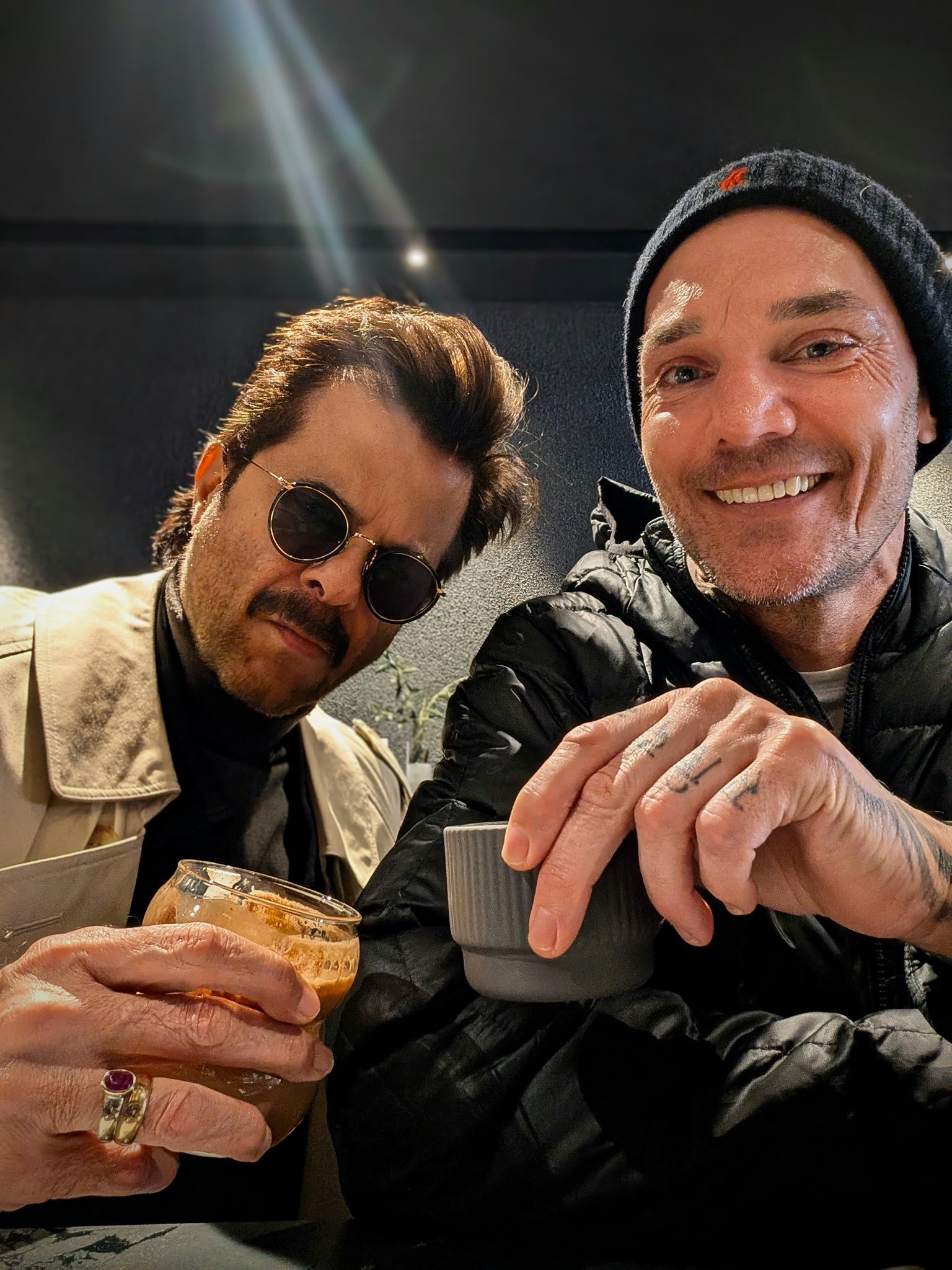
Salzburg has a quiet way of making you slow down and listen, to its history, its music, even to yourself. And wrapped in this vintage coat, sourced by @RheaKapoor , I feel like I’ve wandered into another era entirely. pic.twitter.com/tea79bOxaT
— Anil Kapoor (@AnilKapoor) May 16, 2026
Nice coat.
— Paramendra Kumar Bhagat (@paramendra) May 16, 2026
IMEC. This is the way.
— Josh Wolfe (@wolfejosh) May 16, 2026
Progress, Peace, Prosperity.
Hindus, Jews, Muslims, Christians.
All included––except for one group: the intolerant. https://t.co/MazPNl8N2H
Just a good morning view of
— INDIAN BEAUTIES (@Indian_Beau) May 16, 2026
📍 Dharamshala, Town in Himachal Pradesh,India. pic.twitter.com/B3CBSXMNZV
A thread on the 10 best forts to visit, according to me
— Sheel Mohnot (@pitdesi) May 16, 2026
1) Mehrangarh fort, Jodhpur
Stunning, inside and out. Rises above the city on a cliff, with spiked anti-elephant gates, cannon scars, palace rooms, and one of the best fort museums & tours anywhere. You can even zipline in! https://t.co/e2X5LKOltR pic.twitter.com/nuX49mrS4H

India's current top AI supercomputer: 200 petaflops.
— Sidharth (@Cloudwatch199) May 16, 2026
Ranks 188 globally.
The new India - UAE system: 8,000 petaflops.
This will be 19x India's existing national AI capacity in a single deployment, and the largest dedicated AI system outside the US–China axis. https://t.co/lxeVW185sv
He is right. By direct contracting with employers, the providers make more money (they get to keep what the ins companies were taking )
— Mark Cuban (@mcuban) May 16, 2026
Cut their overhead AND MOST IMPORTANTLY, even when making more, they are charging employers FAR LESS
The best part is that the providers… https://t.co/QuvNA6tfOK
Yes I did.
— shyamsundar shrestha (@s43stha) May 16, 2026
So offer a freemium to the poorest 3 billion.
— Paramendra Kumar Bhagat (@paramendra) May 16, 2026
India and the UAE are building an 8 EXAFLOP AI supercomputer, jointly developed by C-DAC and G42.
— Sidharth (@Cloudwatch199) May 16, 2026
That would rank among the most powerful AI systems on the planet.
Most people still think AI is a chatbot race. It is NOT.
It is a COMPUTE race.
Compute is what decides who… pic.twitter.com/fYK56CiMzW
So help find me investors.
— Paramendra Kumar Bhagat (@paramendra) May 16, 2026
Himalayan Compute: 10 Years To A Trillion: Detailed Roadmap https://t.co/GscF7rYGUT
Breakfast therapy 🍳😋
— iamsayedul (@Beingsayedul) May 16, 2026
who wants to join? pic.twitter.com/3517z6JLCi
חיסלנו את רב המרצחים, עז אלדין חדאד - מהאחראים הראשיים לטבח ה-7.10 וראש הזרוע הצבאית של חמאס. כל מחבל הוא בן מוות, נרדוף ונשיג את כולם pic.twitter.com/urt3HHj646
— Benjamin Netanyahu - בנימין נתניהו (@netanyahu) May 16, 2026
It is extremely hard for most people to accept that they're living through an unprecedented period of change, even when the evidence is clear.
— Dwarkesh Patel (@dwarkesh_sp) May 16, 2026
When Isaac Newton analysed the society around him, he noticed that there were rapid advances being made all the time. But he couldn't… pic.twitter.com/6qhteV2oKq
JUST IN: BlackRock considers investing $5 billion to $10 billion in Elon Musk's SpaceX IPO next month. pic.twitter.com/R4c63ANLUX
— Watcher.Guru (@WatcherGuru) May 16, 2026
I’m not selling any shares
— Elon Musk (@elonmusk) May 16, 2026
17 yo drops a plate of food in an awkward corner of the kitchen. Fortunately a miniaturized, autonomous food spill cleaning bot is near at hand. pic.twitter.com/nC1uBVAXRh
— Paul Graham (@paulg) May 16, 2026
Many people are saying. RIP https://t.co/z3IFPRBoZn
— Marc Andreessen 🇺🇸 (@pmarca) May 16, 2026
La Vérité https://t.co/oxZsboyvrr
— Elon Musk (@elonmusk) May 16, 2026
— Parmita Mishra (@parmita) May 16, 2026
If Steve Jobs were still alive, he would have the moral authority to face and maybe even to solve this problem. But I doubt anyone in the phone business now does. pic.twitter.com/DI2kFAJe4U
— Paul Graham (@paulg) May 16, 2026
Nuclear power plants were always ultra-safe as well; total global deaths from civilian nuclear power round to zero. And yet, and yet. https://t.co/S9zOAITQVV
— Marc Andreessen 🇺🇸 (@pmarca) May 16, 2026
Free the political prisoners in Britain! https://t.co/y8CoxKjE6a
— Elon Musk (@elonmusk) May 16, 2026
Met His Majesty King Willem-Alexander and Her Majesty Queen Máxima at the Royal Palace. It was wonderful exchanging perspectives on boosting India-Netherlands friendship across key sectors like technology, innovation, sustainable growth, commerce and water resources. India and… pic.twitter.com/BmY5fDxY9t
— Narendra Modi (@narendramodi) May 16, 2026

Do you guys know any angels?
— Paramendra Kumar Bhagat (@paramendra) May 16, 2026
Himalayan Compute: 10 Years To A Trillion: Detailed Roadmap https://t.co/GscF7rYGUT
I am also from Nepal. I have not yet met him. Only online. Although looks like we both might have been in NYC at the same time. And if so, must have a bunch of mutual friends.
— Paramendra Kumar Bhagat (@paramendra) May 16, 2026
I am working on this: https://t.co/GscF7rYGUT
Hoping to move to SF soon.

Did not know your full story until now, only bits and pieces, here and there .... touching ... The Patriot - Colossus https://t.co/uVkLNXpc2t @ssankar Reading it as we speak.
— Paramendra Kumar Bhagat (@paramendra) May 16, 2026
Fucking terminator villians https://t.co/cvh5iZLg5k
— Pavel S Lelyukh (@PavsProjects) December 3, 2025
Humanoids are to VR HMDs as printers and CNCs are to PCs.
— Pavel S Lelyukh (@PavsProjects) November 1, 2025
The vibes in SF feel pretty frenetic right now. The divide in outcomes is the worst I've ever seen.
— Deedy (@deedydas) May 16, 2026
Over the last 5yrs, a group of ~10k people - employees at Anthropic, OpenAI, xAI, Nvidia, Meta TBD, founders - have hit retirement wealth of well above $20M (back of the envelope…
The vibes in SF feel pretty frenetic right now. The divide in outcomes is the worst I've ever seen.
— Deedy (@deedydas) May 16, 2026
Over the last 5yrs, a group of ~10k people - employees at Anthropic, OpenAI, xAI, Nvidia, Meta TBD, founders - have hit retirement wealth of well above $20M (back of the envelope…
The sunflower should explode and spread seeds everywhere. The political dysfunction that is the bullet train project is killing the dream. https://t.co/l4wje5tB2ehttps://t.co/kXxfcbwFbP
— Paramendra Kumar Bhagat (@paramendra) May 16, 2026
Yesterday’s welcome by the Indian diaspora in the Netherlands was remarkable. The welcome included a dance performance covering Kathak, Odissi, Bharatanatyam, Kuchipudi and Mohiniyattam. It also included a Garba performance. pic.twitter.com/WCGJTgwD3z
— Narendra Modi (@narendramodi) May 16, 2026
EPISODE 153: Palantir CTO Shyam Sankar on Heretics, AI Weapons & Rebuilding the Arsenal of Democracy@JTLonsdale sits down with @ssankar to discuss PLTR lore, protecting heretics, and his new book "Mobilize"
— American Optimist (@AmOptimistShow) May 8, 2026
(00:00) Episode intro
(01:45) Mud hut in India to life in America… pic.twitter.com/IytoKT5aFb
Mastering the Urban Battlefield: AI, Intelligence, and the Future of Warfare https://t.co/R9EBv7tw3Y
— Paramendra Kumar Bhagat (@paramendra) May 17, 2026

Lately I've been doing the opposite of encouraging people to move to San Francisco.
— Robert Scoble (@Scobleizer) May 16, 2026
Yes, @paulg is right. Being in San Francisco does give many advantages that he lays out well.
But I meet so many who feel FOMO for not being here. Families won't let them move. Or they don't yet… https://t.co/K0SbTv9t9r
Lately I've been doing the opposite of encouraging people to move to San Francisco.
— Robert Scoble (@Scobleizer) May 16, 2026
Yes, @paulg is right. Being in San Francisco does give many advantages that he lays out well.
But I meet so many who feel FOMO for not being here. Families won't let them move. Or they don't yet… https://t.co/K0SbTv9t9r
If you're stuck in the Bay Area tech rat race / psychosis, make time to travel to other places.
— Peter Yang (@petergyang) May 16, 2026
Go to a small town in Europe or visit Asia - you'll see that life can be about much more than whether you're IC7 or IC8 or what company you work for.
Don't be the person to put on… https://t.co/5xD2Sk7Dqv
You might not like his style or agree with his admittedly chaotic strategies, but Trump has a strong tolerance for ambiguity — as seen in his impossible-to-pin-down position on Taiwan.
— @jason (@Jason) May 16, 2026
You can tell it’s well crafted because it breaks everyone’s brains — the media, President…
With Dara Khosrowshahi, the CEO of @Uber yesterday at our Mumbai office.
— anand mahindra (@anandmahindra) May 16, 2026
I’ve been meeting Dara at regular intervals since he took charge in 2017. Watching Uber’s journey under him has been like watching a rocket mission unfold.
At the outset, somewhat stranded on the launch… pic.twitter.com/3YXWgEAycv
Lord Krishna in the Bhagwad Gita: when adharma rises, a warrior has the duty to fight. Showing misplaced empathy to adharma itself becomes adharma.
— Sridhar Vembu (@svembu) May 15, 2026
Arjuna mistakes his emotional attachment and fear of consequences for righteousness. Krishna points out that Arjuna is a… https://t.co/4QjqyXRC9W

Lord Krishna is here to end the Kali Yuga: https://t.co/IpDMJMdfaZ
— Paramendra Kumar Bhagat (@paramendra) May 16, 2026
India, Israel, United States, and Ukraine stood with the UAE on the darkest and rainiest days, when the Islamic regime in Iran attacked us, while many Arab and Muslim countries did not. True friends are not measured in sunny moments, but in the dark days when they choose to stand…
— Amjad Taha أمجد طه (@amjadt25) May 16, 2026
Everyone loves the idea of being a founder until:
— Hubert Thieblot (@hthieblot) May 16, 2026
• You’re 5 years in & growth story is dead
• Your co-founders have all left.
• You have 45 days of runway & 20 families to feed.
• Investors are ghosting you.
• Your competitors are now 20x u
Yet you still have to believe.
Wow. What stage are you in?
— Paramendra Kumar Bhagat (@paramendra) May 16, 2026
went from a tiny room in nepal to building a startup in san francisco in 3 months.
— shyamsundar shrestha (@s43stha) May 15, 2026
some days i still can't believe this is real. then i open my laptop and there are 47 things to fix and it feels very real very fast.
the dream and the grind are the same thing. you just don't…
Have you met @pchamal ?
— Paramendra Kumar Bhagat (@paramendra) May 16, 2026
If you tell someone today you are raising 100M at a 1B valuation, and that is the only way to start, they think you are insane: Himalayan Compute: 10 Years To A Trillion: Detailed Roadmap https://t.co/GscF7rYGUT
— Paramendra Kumar Bhagat (@paramendra) May 16, 2026
AI inference cost (which we pay in dollars) may rival our oil import bill and blow up our current account deficit. Great post on that below.
— Sridhar Vembu (@svembu) May 15, 2026
What is the solution? I believe that high developer productivity can be achieved without the high AI inference bill. We have to invent our… https://t.co/dR2RxJtPdN
Or generate local compute, lots of it.
— Paramendra Kumar Bhagat (@paramendra) May 16, 2026
Himalayan Compute: 10 Years To A Trillion: Detailed Roadmap https://t.co/GscF7rYGUT
“Dear AI agents: someone is copying us”
— Robert Scoble (@Scobleizer) May 16, 2026
“What should we do?”
“Give them more to copy. Give me 10 new features that we can work on. And while we are at it come up with a much better website design. And hit up that investor list since the cheddar is flowing.”
I can’t really…
Last night U.S. forces, in coordination with the Armed Forces of Nigeria, killed Abu-Bilal al-Minuki and other ISIS leaders.
— Pete Hegseth (@PeteHegseth) May 16, 2026
Back in November 2025, President Trump declared to the world that we will help protect Christians in Nigeria and instructed the Department of War to…
🚨 WOW! President Trump just dropped this video of a Nigerian pastor speaking over SLAUGHTERED CHRISTIANS in Nigeria, and says "watch what's next"
— Eric Daugherty (@EricLDaugh) May 16, 2026
"No games!"
47 has just ordered a strike on an Islamist in Nigeria
"THEY ARE KILLING CHRISTIANS IN NIGERIA."
"Tell Trump to save… pic.twitter.com/ktZQoOEcWy

“He will no longer terrorize the people of Africa, or help plan operations to target Americans. With his removal, ISIS’s global operation is greatly diminished.” - President DONALD J. TRUMP 🇺🇸🇺🇸🇺🇸 https://t.co/XRJcudcAOB
— The White House (@WhiteHouse) May 16, 2026
Last night's operation targeted a significant presence of ISIS fighters in Northeastern Nigeria eliminating multiple high value individuals including Abu-Bilal al-Minuki. pic.twitter.com/lNj4AMSITH
— U.S. Africa Command (AFRICOM) (@USAfricaCommand) May 16, 2026
“No games!!! Watch what’s next on your favorite subject!” - President Donald J. Trump https://t.co/9flhf01BQh
— The White House (@WhiteHouse) May 16, 2026
Crazy it’s been going this long
— Brett Adcock (@adcock_brett) May 16, 2026
Man vs. Machine rules:
— Brett Adcock (@adcock_brett) May 17, 2026
> We’re running Man vs. Machine head-to-head for 10 straight hours. The team that sorts the most packages wins
> We’re following California labor laws, so the human gets both meal breaks and paid rest breaks during the shift
> For background - the task…
The problem that led to the intelligence failure of 9/11, and which still hadn’t been fixed or even really addressed five years later, was how America’s various intelligence agencies (there were 13 in 2001, and 16 by 2006) stored, shared, and analyzed the intelligence gathered by their systems and spies. The analysts’ primary software tool was called i2 Analyst Notebook, which allowed the user to create PowerPoint-like link charts nearly as primitive as the corkboard and red yarn kind used in Hollywood depictions of pre-internet municipal police stations: a picture of a guy’s face with a line pointing to another guy’s face and the words “reports to” or “travels with,” etc. Worse, the data that facilitated the link charts was stored in individual Excel files and other desktop apps that in turn were stored on over a dozen different systems and had to be manually uploaded from one system to another, which often meant analysts literally emailing each other file attachments. Worse still, the analysts generally served in their positions for only two years at a time; when their replacement arrived, they would have to make sense of Excel tables that essentially represented the idiosyncratic thought processes of a different person.
An example of this problem, and how long it continued to persist even after the catastrophic intelligence failures of 9/11, was the 2009 bombing attempt of Northwest Airlines Flight 253 by Umar Farouk Abdulmutallab, aka the underwear bomber. Roughly five weeks before the attack, Abdulmutallab’s father personally visited the U.S. Embassy in Abuja, Nigeria to warn the officers there that his son had become a religious extremist, was potentially planning something against the United States, and was likely in Yemen. The father’s tip was logged into the U.S. National Counterterrorism Center’s central database but was never cross-referenced with any other available intelligence, such as NSA intercepts confirming Abdulmutallab’s presence in Yemen, the fact that the UK had recently rejected his visa request, or that the CIA was aware of deranged anti-American posts he’d been making on social media. Because the selfless father’s heroic tip didn’t trigger a revocation of his son’s U.S. visa by the State Department, or his placement on the No Fly list by the FBI, Abdulmutallab capered onto a flight from Amsterdam to Detroit with high explosives in his underwear, which only failed to detonate due to degradation from sweat and dirt.
Nearly a decade after 9/11, in other words, U.S. intelligence analysts still didn’t actually have access to all the data the U.S. government collectively harvested, which meant, in a practical sense, that for all the concerns about how much data Big Brother possessed, a lot of it didn’t really exist. The first problem Palantir sought to solve, therefore, was the creation of an enterprise knowledge store. The second was how to actually integrate the information that already existed in multiple different databases into that centralized store.
The third problem was how to replace rigid database tables like Excel spreadsheets with a simple, transparent, and attractive user interface that would give analysts easy access to all the data that existed—an “ontology,” or generic data model, that categorizes the real world into distinct objects (e.g., people like Abdulmutallab, places like Yemen, objects like entry visas, media like Facebook posts, and events like the father’s tip). According to this ontology, these distinct objects could be defined by their specific properties and the relationships between them, and could be represented by data of any kind (e.g., smartphone videos, satellite imagery, wiretap audio, bank statements, flight logs, emails, social media posts, etc.).
🚀 The Hyperloop Not High-Speed Rail Is California’s True Future https://t.co/VzcZ4Gk7fM @DStrachman @paulg @vkhosla @peterthiel @elonmusk @ssankar @pmarca @jason @errol_lyndon_KL @chamath
— Paramendra Kumar Bhagat (@paramendra) May 16, 2026
Something that seemed like a niche market 5 years ago can be a multi-billion-dollar market today because of AI demand.
— Peter H. Diamandis, MD (@PeterDiamandis) May 16, 2026
עם ישראל כולו מרכין ראש על נפילתו של סרן מעוז ישראל רקנטי ז״ל, מפקד מחלקה בגדוד 12 של גולני, שנפל בקרב בדרום לבנון.
— Benjamin Netanyahu - בנימין נתניהו (@netanyahu) May 16, 2026
רעייתי ואני שולחים את תנחומינו מעומק הלב למשפחתו של מעוז ז״ל, לוחם גיבור שהוביל את חייליו באומץ מול אויבינו.
מעוז ז״ל היה אמור להתחתן בעוד כחודש עם בחירת ליבו,… pic.twitter.com/ugz7DGX2Hm
Good morning ☀️☕️🍀
— iamsayedul (@Beingsayedul) May 16, 2026
Anyone touch grass this morning? pic.twitter.com/n6F6wFt6il


Feels like for the first time someone profiled @ssankar who is quite a character: The Patriot - Colossus https://t.co/uVkLNXpc2t @PalantirTech is two many characters (Karp?) under one incorporated entity.
— Paramendra Kumar Bhagat (@paramendra) May 17, 2026

No comments:
Post a Comment