
The Technologies Devouring Tradition: AI Eats Software, Robotics Eats Labor, Crypto Eats Settlement, and Biotech Eats Aging
In 2011, Marc Andreessen wrote that “software is eating the world.” The prediction proved prophetic: every industry from retail to media to transportation was remade by code. Fifteen years later, the menu has changed. A new quartet of exponential technologies is now consuming the very structures that software once built—and the human systems that powered civilization for centuries.
AI is eating software.
Robotics is eating labor.
Crypto is eating settlement.
Biotech is eating aging.
These are not slogans. They are observable, accelerating realities in 2026. Together they point to an era of radical abundance, profound dislocation, and a complete redefinition of what humans do, how value is created, and how long we live.AI Is Eating SoftwareThe phrase itself comes from Nvidia CEO Jensen Huang, who updated Andreessen’s line in 2017: “Software is eating the world… but AI is eating software.” By early 2026 the market finally believed him. Software stocks suffered a brutal “SaaSpocalypse” as investors realized generative AI and autonomous agents were commoditizing what used to be defensible moats.
Enterprises discovered they no longer needed to buy expensive off-the-shelf applications. They could build their own. Walmart integrated agentic AI and proprietary models to run its omnichannel empire. John Deere slashed chemical use 70% and boosted farmer productivity 15–20% with AI-driven autonomy. Siemens achieved 99.9988% quality and cut scrap costs 75% through predictive AI. Caterpillar, Ford, Gilead, Lemonade, and Amdocs all posted record or near-record performance while legacy SaaS names bled value.
Andreessen Horowitz called it the “great software bifurcation.” Thin wrappers, archaic systems, and high-priced middlemen die. Companies with real ecosystems, network effects, and workflow depth (think Salesforce, Stripe, Figma, or AI-native players like Harvey and Hebbia) survive and grow. The industry doesn’t shrink—it explodes. Demand for high-quality software is nowhere near saturated; AI simply makes it radically cheaper and faster to create.
Sixty-five percent of developers now use AI coding tools weekly. Microsoft and Google report roughly 30% of their code is AI-generated. Junior developer employment has already dropped nearly 20% in some cohorts. The role of the software engineer is shifting from writing every line to orchestrating intelligent systems. Code is no longer the scarce resource; context, taste, and integration are.Robotics Is Eating LaborWhile AI hollows out knowledge work inside software, robotics is doing the same to physical labor.
Humanoid robots crossed an economic Rubicon in 2025–2026. Payback periods versus human workers are now measured in weeks, not years. A $15,000–$35,000 robot can break even against a $41/hour worker in under 10 weeks—or against minimum-wage labor in months. Costs are falling on a trajectory toward under $1/hour before 2035 and pennies later.
Factories are already voting with their feet. Hyundai plans to produce 30,000 humanoids annually; by 2032 robots will outnumber people on many of its lines. Agility Robotics’ Digit, Figure’s 02, and Tesla’s Optimus are moving from pilots to production floors. Amazon, BMW, and countless warehouses already run thousands of mobile robots; the humanoid wave simply extends that automation to every task requiring dexterity and mobility.
RethinkX projects humanoid robots will disrupt human labor across every major industry within 15–20 years. The disruption is not total replacement tomorrow but inevitable substitution at scale. Repetitive, dangerous, or precision tasks vanish first. Humans shift to oversight, creativity, and new roles that emerge around robot fleets. The economic implication is the same as every previous automation wave—productivity surges, prices fall, and entirely new categories of work appear—but the speed and breadth this time are unprecedented. Crypto Is Eating SettlementFinancial settlement—the final, irreversible transfer of value—has been the slow, expensive, gated province of banks, clearing houses, and legacy rails for centuries. T+2 stock settlement, SWIFT wires that take days, 1–3% foreign-exchange fees, and middlemen skimming every layer.
Blockchain and crypto collapse that latency to seconds or minutes, at near-zero marginal cost, 24/7/365, with cryptographic finality.
Stablecoins now handle hundreds of billions in monthly volume, bypassing correspondent banking. Tokenized real-world assets (RWAs) exploded onto chain: Ondo Global Markets launched tokenized U.S. stocks and ETFs in September 2025, enabling 24/7 on-chain trading of Apple, Nvidia, and Tesla. The total addressable market for RWAs is measured in hundreds of trillions; crypto has barely nibbled 0.1% so far.
Solana founder Anatoly Yakovenko frames it bluntly: crypto is “eating the last big part of the world, which is finance.” DeFi protocols already settle more value daily than many traditional exchanges. Central banks are racing to launch CBDCs or integrate with public chains precisely because the old settlement infrastructure is becoming obsolete. Every asset class—equities, real estate, bonds, commodities—is being tokenized and traded natively on-chain. The economic flywheel is self-reinforcing: faster, cheaper settlement creates more liquidity, which creates more activity, which pulls more capital away from legacy rails.Biotech Is Eating AgingFor all of human history, aging was the ultimate non-negotiable constraint. It was biology’s tax on existence.In 2026 that tax is being audited, renegotiated, and in some labs, repealed at the cellular level.
The longevity biotech sector has moved from billionaire hobby to mainstream pharmaceutical priority. Private investment in longevity science more than doubled in a single year to $8.49 billion. The FDA cleared its first longevity-focused drug pathway in 2025 (Loyal’s LOY-002 for aging dogs), formally recognizing lifespan extension as a valid clinical endpoint. Big Pharma is acquiring and partnering aggressively.
Leading companies are attacking aging at its root:
AI agents will pilot humanoid robots. Crypto rails will fund and tokenize biotech breakthroughs. Robotic labor will free humans to pursue longer, healthier lives. Software built by AI will design the next generation of all four technologies.
The result is a world of radical abundance: software nearly free, physical labor nearly free, capital moving at the speed of light, and human lifespan potentially measured in centuries rather than decades. The productivity gains could dwarf the Industrial Revolution.
Yet abundance without adaptation creates friction. Labor markets must re-skill at unprecedented speed. Financial systems must modernize regulation without stifling innovation. Societies must decide how to distribute the gains of longevity and automation. The policy questions are real; the technological momentum is relentless.
History shows that when technology eats old constraints, humanity does not shrink—it expands. We invent new problems to solve, new frontiers to explore, new meanings to pursue. The same will be true here.Software ate the world.
Now these four technologies are eating the next layer of reality.
And the universe, as always, is just getting started.
In 2011, Marc Andreessen wrote that “software is eating the world.” The prediction proved prophetic: every industry from retail to media to transportation was remade by code. Fifteen years later, the menu has changed. A new quartet of exponential technologies is now consuming the very structures that software once built—and the human systems that powered civilization for centuries.
AI is eating software.
Robotics is eating labor.
Crypto is eating settlement.
Biotech is eating aging.
These are not slogans. They are observable, accelerating realities in 2026. Together they point to an era of radical abundance, profound dislocation, and a complete redefinition of what humans do, how value is created, and how long we live.AI Is Eating SoftwareThe phrase itself comes from Nvidia CEO Jensen Huang, who updated Andreessen’s line in 2017: “Software is eating the world… but AI is eating software.” By early 2026 the market finally believed him. Software stocks suffered a brutal “SaaSpocalypse” as investors realized generative AI and autonomous agents were commoditizing what used to be defensible moats.
Enterprises discovered they no longer needed to buy expensive off-the-shelf applications. They could build their own. Walmart integrated agentic AI and proprietary models to run its omnichannel empire. John Deere slashed chemical use 70% and boosted farmer productivity 15–20% with AI-driven autonomy. Siemens achieved 99.9988% quality and cut scrap costs 75% through predictive AI. Caterpillar, Ford, Gilead, Lemonade, and Amdocs all posted record or near-record performance while legacy SaaS names bled value.
Andreessen Horowitz called it the “great software bifurcation.” Thin wrappers, archaic systems, and high-priced middlemen die. Companies with real ecosystems, network effects, and workflow depth (think Salesforce, Stripe, Figma, or AI-native players like Harvey and Hebbia) survive and grow. The industry doesn’t shrink—it explodes. Demand for high-quality software is nowhere near saturated; AI simply makes it radically cheaper and faster to create.
Sixty-five percent of developers now use AI coding tools weekly. Microsoft and Google report roughly 30% of their code is AI-generated. Junior developer employment has already dropped nearly 20% in some cohorts. The role of the software engineer is shifting from writing every line to orchestrating intelligent systems. Code is no longer the scarce resource; context, taste, and integration are.Robotics Is Eating LaborWhile AI hollows out knowledge work inside software, robotics is doing the same to physical labor.
Humanoid robots crossed an economic Rubicon in 2025–2026. Payback periods versus human workers are now measured in weeks, not years. A $15,000–$35,000 robot can break even against a $41/hour worker in under 10 weeks—or against minimum-wage labor in months. Costs are falling on a trajectory toward under $1/hour before 2035 and pennies later.
Factories are already voting with their feet. Hyundai plans to produce 30,000 humanoids annually; by 2032 robots will outnumber people on many of its lines. Agility Robotics’ Digit, Figure’s 02, and Tesla’s Optimus are moving from pilots to production floors. Amazon, BMW, and countless warehouses already run thousands of mobile robots; the humanoid wave simply extends that automation to every task requiring dexterity and mobility.
RethinkX projects humanoid robots will disrupt human labor across every major industry within 15–20 years. The disruption is not total replacement tomorrow but inevitable substitution at scale. Repetitive, dangerous, or precision tasks vanish first. Humans shift to oversight, creativity, and new roles that emerge around robot fleets. The economic implication is the same as every previous automation wave—productivity surges, prices fall, and entirely new categories of work appear—but the speed and breadth this time are unprecedented. Crypto Is Eating SettlementFinancial settlement—the final, irreversible transfer of value—has been the slow, expensive, gated province of banks, clearing houses, and legacy rails for centuries. T+2 stock settlement, SWIFT wires that take days, 1–3% foreign-exchange fees, and middlemen skimming every layer.
Blockchain and crypto collapse that latency to seconds or minutes, at near-zero marginal cost, 24/7/365, with cryptographic finality.
Stablecoins now handle hundreds of billions in monthly volume, bypassing correspondent banking. Tokenized real-world assets (RWAs) exploded onto chain: Ondo Global Markets launched tokenized U.S. stocks and ETFs in September 2025, enabling 24/7 on-chain trading of Apple, Nvidia, and Tesla. The total addressable market for RWAs is measured in hundreds of trillions; crypto has barely nibbled 0.1% so far.
Solana founder Anatoly Yakovenko frames it bluntly: crypto is “eating the last big part of the world, which is finance.” DeFi protocols already settle more value daily than many traditional exchanges. Central banks are racing to launch CBDCs or integrate with public chains precisely because the old settlement infrastructure is becoming obsolete. Every asset class—equities, real estate, bonds, commodities—is being tokenized and traded natively on-chain. The economic flywheel is self-reinforcing: faster, cheaper settlement creates more liquidity, which creates more activity, which pulls more capital away from legacy rails.Biotech Is Eating AgingFor all of human history, aging was the ultimate non-negotiable constraint. It was biology’s tax on existence.In 2026 that tax is being audited, renegotiated, and in some labs, repealed at the cellular level.
The longevity biotech sector has moved from billionaire hobby to mainstream pharmaceutical priority. Private investment in longevity science more than doubled in a single year to $8.49 billion. The FDA cleared its first longevity-focused drug pathway in 2025 (Loyal’s LOY-002 for aging dogs), formally recognizing lifespan extension as a valid clinical endpoint. Big Pharma is acquiring and partnering aggressively.
Leading companies are attacking aging at its root:
- Altos Labs (backed by $3B+) uses partial epigenetic reprogramming with Yamanaka factors to reset cellular age; it extended mouse lifespan in published 2024 work and is now testing in perfused organs.
- Retro Biosciences (Sam Altman-backed, reportedly raising toward $1B) focuses on HSC reprogramming and autophagy; it dosed its first Alzheimer’s patient in 2025.
- Life Biosciences, New Limit, Junevity, clock.bio, Rubedo, and others are advancing senolytics, siRNA resetting, AI-driven discovery, and gene therapies targeting specific age-related decline.
AI agents will pilot humanoid robots. Crypto rails will fund and tokenize biotech breakthroughs. Robotic labor will free humans to pursue longer, healthier lives. Software built by AI will design the next generation of all four technologies.
The result is a world of radical abundance: software nearly free, physical labor nearly free, capital moving at the speed of light, and human lifespan potentially measured in centuries rather than decades. The productivity gains could dwarf the Industrial Revolution.
Yet abundance without adaptation creates friction. Labor markets must re-skill at unprecedented speed. Financial systems must modernize regulation without stifling innovation. Societies must decide how to distribute the gains of longevity and automation. The policy questions are real; the technological momentum is relentless.
History shows that when technology eats old constraints, humanity does not shrink—it expands. We invent new problems to solve, new frontiers to explore, new meanings to pursue. The same will be true here.Software ate the world.
Now these four technologies are eating the next layer of reality.
And the universe, as always, is just getting started.
AI-Robotics Convergence: When Software Brains Meet Physical Bodies
In the 2026 landscape, the phrase from our earlier exploration—“AI agents will pilot humanoid robots”—is no longer a prediction. It is happening in real time. At CES 2026, humanoid robots filled exhibition halls while Nvidia CEO Jensen Huang declared that “AI and robotics will go together” to advance the entire industry. What we are witnessing is the full convergence of artificial intelligence and robotics: the marriage of high-level reasoning, multimodal perception, and end-to-end learning with dexterous hardware that can walk, grasp, balance, and manipulate the physical world.
This is embodied AI or physical AI—intelligence that is no longer trapped in servers or chat windows but anchored in a body that experiences gravity, friction, and chaos. The result is shifting robotics from narrow, pre-programmed machines to general-purpose agents capable of learning on the job, just like software agents learned to code or browse.The Technical Core: Foundation Models Power the ConvergenceThe breakthrough enabling this moment is the rise of robotics foundation models—large neural networks (often Vision-Language-Action or VLA models) trained on massive datasets of video, robot trajectories, simulation, and real-world interactions. These models translate pixels directly into torques and actions, bypassing traditional hand-crafted code.
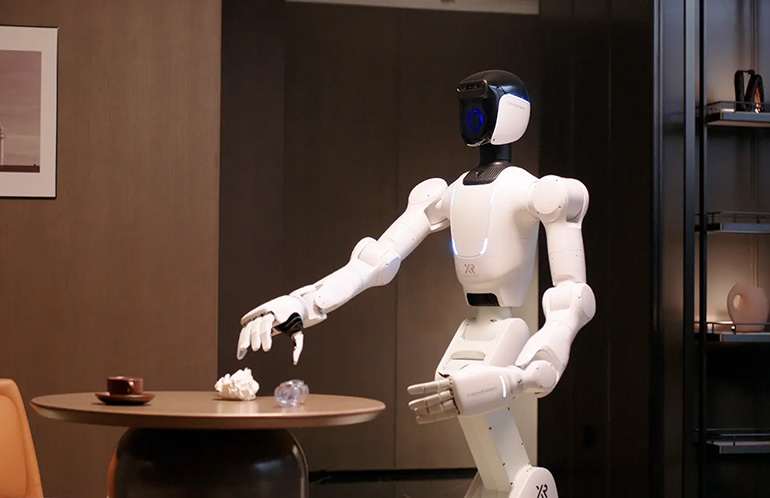
Tesla Optimus: AI Heritage from Cars to BodiesTesla’s Optimus program exemplifies the convergence. Built on the same end-to-end neural networks that power Full Self-Driving (FSD), Optimus uses vision-only perception (multiple cameras) and real-time 3D mapping. Gen 2 has already been deployed internally in Tesla factories; Gen 3—confirmed for production ramp starting summer 2026—adds refined dexterity, faster actuators, and deeper integration with xAI’s Grok models for reasoning and voice interaction.
Optimus learns via massive simulation (“Sim-to-Real”) plus imitation from human video data. It self-corrects failed grasps and adapts without reprogramming. Elon Musk has positioned it as the path to “universal high income” through abundance, with Digital Optimus (a virtual counterpart) extending the same AI to screen-based tasks.


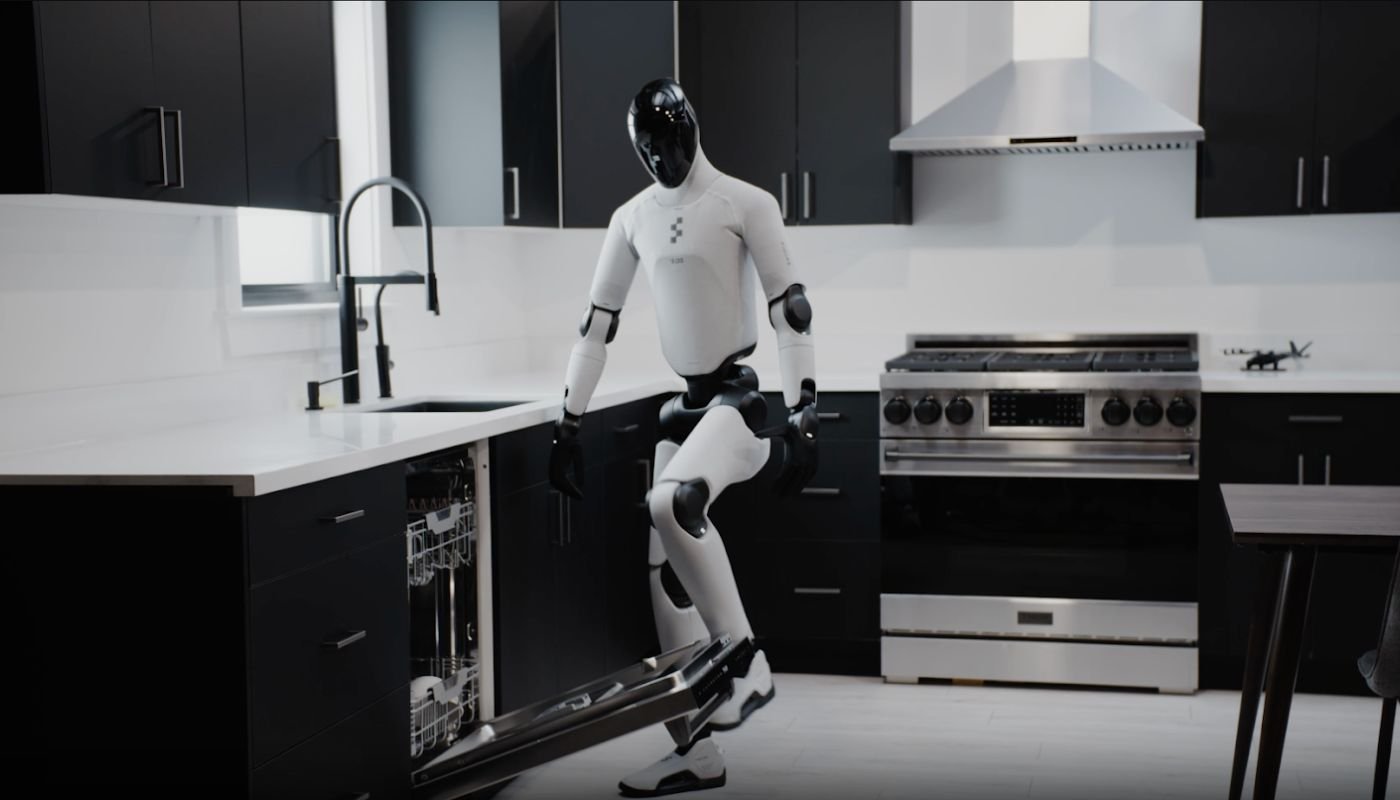
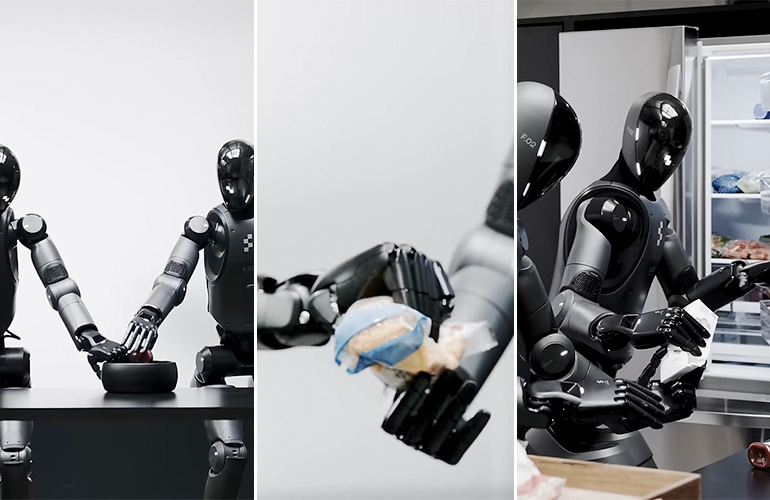
Figure AI: Full-Body Neural Control ArrivesFigure’s Helix 02 (released January 2026) represents perhaps the purest expression of convergence yet. A single neural system controls the entire robot—legs, torso, arms, hands—from raw pixels. Walking, balancing, and manipulation happen as one continuous process, enabling room-scale autonomy.Figure 03 robots are now running 24/7 unsupervised, performing complex household tasks: coordinated tool use (spray bottle + towel), bimanual manipulation, object throwing, in-hand reorientation, and precise foot placement while moving. Demos show seamless dishwasher unloading, cleaning, and multi-step chores in unseen environments. CEO Brett Adcock predicts unsupervised multi-day tasks in novel homes by the end of 2026.
The hardware-software loop is accelerating: better actuators (3–5× headroom in speed) paired with learned whole-body control.
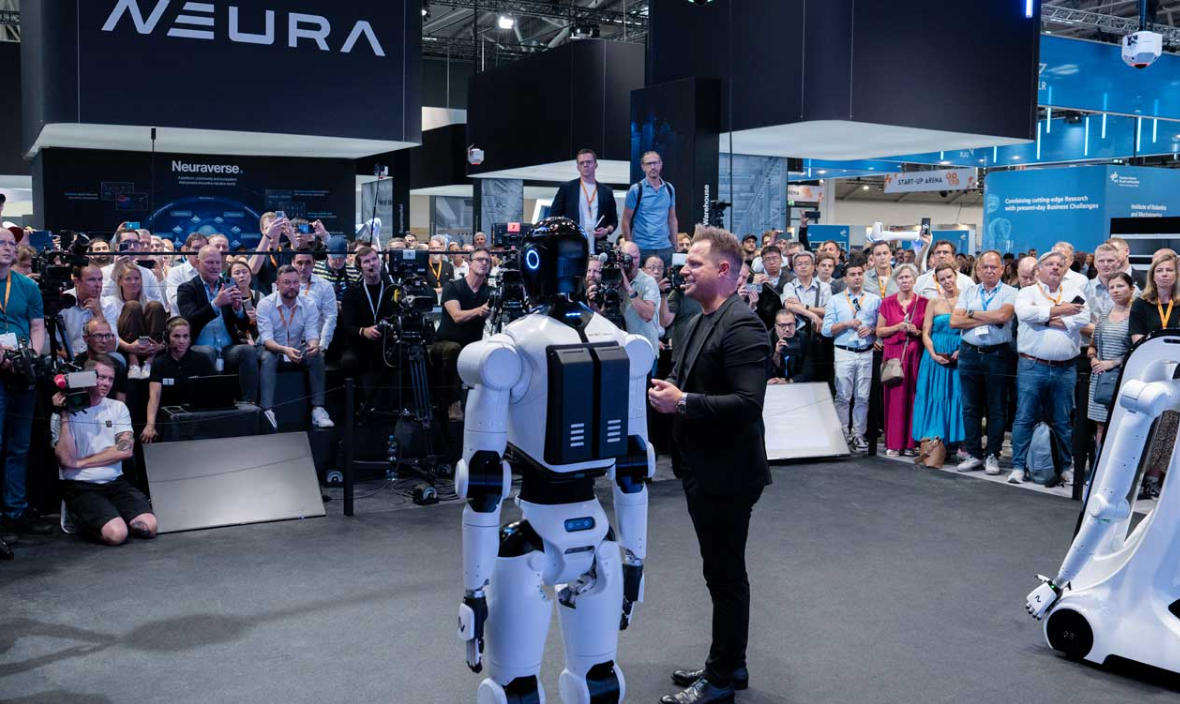
CES 2026: The Convergence on DisplayThe Las Vegas show floor in January 2026 made the trend undeniable. Humanoids from Figure, Tesla-inspired designs, NEURA Robotics, LG, Hyundai/Boston Dynamics evolutions, and Chinese innovators (Unitree, Engine AI, and more) demonstrated fluid movement, real-time decision-making, and practical applications—from factory assistance to home helpers.
Nvidia’s stage featured multiple robots; analysts noted the shift from demos to early commercial reality. International Federation of Robotics named “AI & Autonomy in Robotics” the #1 global trend for 2026, citing IT/OT convergence and versatile, adaptive systems.

Impacts: Accelerating the “Robotics Eats Labor” ThesisThis convergence supercharges the economic transformation outlined previously. Payback periods for humanoids are collapsing to months or weeks. Factories (BMW with Figure, Tesla internal, Hyundai planning thousands) are moving from pilots to scale. Homes are next: 1X NEO shipments, Figure household pilots.
Productivity surges as AI agents orchestrate fleets of robots. One foundation model can be copied across millions of bodies, sharing skills instantly. Labor shortages in manufacturing, logistics, eldercare, and services are addressed not by replacement but by augmentation—freeing humans for higher-value work.Combined with crypto settlement rails and biotech longevity, the flywheel spins faster: AI designs better robots, robots build more AI infrastructure, capital flows at light speed, humans live longer to enjoy the abundance.Challenges on the HorizonConvergence is not frictionless:
The AI-robotics convergence is not just another technology wave. It is the moment intelligence escapes the digital realm and becomes physical at planetary scale. Software ate the world. Now AI is giving robots the brains to eat labor—and together they are building the abundant future we only imagined.
The bodies are here. The brains have arrived. The universe is about to get a lot more interesting.
In the 2026 landscape, the phrase from our earlier exploration—“AI agents will pilot humanoid robots”—is no longer a prediction. It is happening in real time. At CES 2026, humanoid robots filled exhibition halls while Nvidia CEO Jensen Huang declared that “AI and robotics will go together” to advance the entire industry. What we are witnessing is the full convergence of artificial intelligence and robotics: the marriage of high-level reasoning, multimodal perception, and end-to-end learning with dexterous hardware that can walk, grasp, balance, and manipulate the physical world.
This is embodied AI or physical AI—intelligence that is no longer trapped in servers or chat windows but anchored in a body that experiences gravity, friction, and chaos. The result is shifting robotics from narrow, pre-programmed machines to general-purpose agents capable of learning on the job, just like software agents learned to code or browse.The Technical Core: Foundation Models Power the ConvergenceThe breakthrough enabling this moment is the rise of robotics foundation models—large neural networks (often Vision-Language-Action or VLA models) trained on massive datasets of video, robot trajectories, simulation, and real-world interactions. These models translate pixels directly into torques and actions, bypassing traditional hand-crafted code.
- A single model can now control an entire robot: perception, planning, locomotion, and manipulation.
- Techniques like sim-to-real transfer, imitation learning from human videos, and reinforcement learning allow robots to self-correct and generalize.
- Scaling laws are emerging: larger models, more data, and better hardware yield rapid capability jumps.
Optimus learns via massive simulation (“Sim-to-Real”) plus imitation from human video data. It self-corrects failed grasps and adapts without reprogramming. Elon Musk has positioned it as the path to “universal high income” through abundance, with Digital Optimus (a virtual counterpart) extending the same AI to screen-based tasks.
The hardware-software loop is accelerating: better actuators (3–5× headroom in speed) paired with learned whole-body control.
Nvidia’s stage featured multiple robots; analysts noted the shift from demos to early commercial reality. International Federation of Robotics named “AI & Autonomy in Robotics” the #1 global trend for 2026, citing IT/OT convergence and versatile, adaptive systems.
Productivity surges as AI agents orchestrate fleets of robots. One foundation model can be copied across millions of bodies, sharing skills instantly. Labor shortages in manufacturing, logistics, eldercare, and services are addressed not by replacement but by augmentation—freeing humans for higher-value work.Combined with crypto settlement rails and biotech longevity, the flywheel spins faster: AI designs better robots, robots build more AI infrastructure, capital flows at light speed, humans live longer to enjoy the abundance.Challenges on the HorizonConvergence is not frictionless:
- Generalization: Real-world chaos (unseen homes, dynamic environments) still challenges even frontier models.
- Safety & Reliability: 24/7 autonomy raises liability questions; new “Center for the Advancement of Humanoid Safety” initiatives are emerging.
- Hardware Limits: Battery life (often ~90 minutes today), actuator durability, and cost must continue falling.
- Societal: Job transition speed, ethical “uncanny valley” reactions, and regulation lag behind technical progress.
- Energy: Training and running fleets of embodied AI will demand massive compute and power.
- Tens to hundreds of thousands of deployed humanoids (Figure alone targets 100,000+ by 2029).
- Robots learning entirely from video and experience, with agentic AI planning multi-day tasks.
- Cross-company skill sharing and open-source VLA progress closing gaps.
- Integration with other convergences: crypto-tokenized robot economies, biotech-enhanced human-robot symbiosis, AI-designed next-gen hardware.
The AI-robotics convergence is not just another technology wave. It is the moment intelligence escapes the digital realm and becomes physical at planetary scale. Software ate the world. Now AI is giving robots the brains to eat labor—and together they are building the abundant future we only imagined.
The bodies are here. The brains have arrived. The universe is about to get a lot more interesting.

No comments:
Post a Comment