

Kimi K3: Moonshot AI's 2.8 Trillion-Parameter Open-Weight Frontier Model Shakes Up the AI Landscape
On July 16, 2026, Beijing-based Moonshot AI released Kimi K3, a massive multimodal AI model that quickly captured global attention. As the latest flagship in the Kimi series, it stands as the world's largest announced open-weight model to date, with 2.8 trillion total parameters. It delivers performance that places it among the absolute top tier—trailing only Anthropic's Claude Fable 5 and OpenAI's GPT-5.6 Sol on many independent benchmarks while excelling in key areas like long-horizon coding and agentic tasks.
Background on Moonshot AI and the Kimi Family
Moonshot AI was founded in March 2023 in China. The company launched its first Kimi model in October 2023, notable early on for strong long-context capabilities (initially up to 128K tokens). Subsequent iterations built momentum: the open-weights Kimi K2 arrived in July 2025, followed by variants like K2 Thinking (November 2025), K2.5, and K2.6 (a multimodal model in April 2026).
Kimi K3 represents a major leap forward. It builds on prior versions with architectural innovations while scaling aggressively. The model is already available via the Kimi platform (web, iOS, Android apps), Kimi Work desktop client, Kimi Code, and API. Full model weights were scheduled for release by July 27, 2026, making it accessible for self-hosting, fine-tuning, and community innovation.
Technical Specifications and Architecture
Kimi K3 is a sparse Mixture-of-Experts (MoE) model:
- 2.8 trillion total parameters, with only 16 out of 896 experts activated per token (roughly 1.8% active). This keeps inference costs manageable despite the scale—closer to a much smaller dense model in practice.
- 1-million-token context window (1,048,576 tokens), enabling it to handle enormous inputs like entire code repositories, long documents, or extended conversations.
- Native multimodal capabilities: Text, image, and video understanding (inputs); text output. It supports visual feedback loops, such as analyzing its own generated interfaces or designs.
- Key innovations: Kimi Delta Attention (KDA, a hybrid linear attention mechanism) and Attention Residuals (AttnRes). These improve information flow in deep, long-sequence models and enable up to 6.3x faster decoding at million-token scales. Moonshot reports roughly 2.5x better scaling efficiency than K2.
- Reasoning features: Always-on "thinking mode" (max effort at launch), with plans for adjustable levels. Strong tool use, structured outputs, and context caching.
The architecture targets long-horizon tasks—sustained software engineering, complex knowledge work, agentic workflows, and deep reasoning—rather than simple Q&A.
Pricing (API): $3 per million input tokens (non-cached), $0.30 cached, $15 per million output tokens. This is more premium than many prior Chinese models but still competitive with Western frontier offerings.
Performance and Benchmarks
Kimi K3 debuts strongly on independent evaluations:
- Artificial Analysis Intelligence Index v4.1: 57.1 (4th overall, behind Claude Fable 5 at 59.9 and GPT-5.6 Sol at 58.9; ahead of Claude Opus 4.8 at 55.7).
- GDPval-AA v2 (Elo, economically valuable knowledge work): Around 1,668–1,687 (strong improvement from prior Kimi versions; competitive or ahead of Opus 4.8).
It particularly shines in coding and agentic benchmarks:
- #1 on Arena.ai Frontend Code Arena (1,679 points, ahead of Claude Fable 5), topping 6 of 7 domains (e.g., brand/marketing, data/analytics, consumer products).
- Strong scores on Terminal-Bench 2.1 (88.3), BrowseComp (91.2), SWE Marathon (42.0, leading in some reports), and others. It often leads or ties in practical software engineering and agentic tasks.
Vendor and independent tests confirm it trails the absolute leaders on broad intelligence but outperforms most competitors (including many proprietary models) in specialized, real-world scenarios. Hallucination rates may be slightly higher than predecessors in some evaluations.
Why Kimi K3 Has Been Making Waves
Several factors explain the excitement and market impact:
- Scale + Open Weights at Frontier Level: It is the first open model in the ~3T-parameter class. Releasing weights democratizes access, allowing global developers, researchers, and companies to run, modify, and build on it—potentially turning others' compute into an advantage for Moonshot. This contrasts with closed U.S. leaders and echoes (but surpasses) prior Chinese open models like DeepSeek.
- Closes the Gap with U.S. Frontier Models: In a context of U.S. export controls on advanced chips, Kimi K3 demonstrates China's ability to innovate architecturally (MoE sparsity, custom attention) and compete closely on performance. It has sparked "another DeepSeek moment" discussions, with analysts noting an "all-round catch-up."
- Practical Strengths and Demand: Exceptional for coding, visual/agentic workflows, and long-context work. Demand overwhelmed Moonshot's capacity, leading to a temporary pause on new subscriptions days after launch.
- Geopolitical and Market Ripples: The release coincided with broader AI news, contributing to temporary sell-offs in chip and tech stocks. It highlights shifting dynamics in the global AI race, with implications for valuations, investment, and open vs. closed model strategies. Moonshot reportedly eyes high valuations and potential listing.
- Broader Ecosystem Signal: It signals maturing Chinese AI capabilities in efficiency, multimodality, and agentic systems. While not the cheapest option (marking a shift from "super cheap" Chinese models), its pricing and openness could accelerate adoption and innovation.
Limitations and Outlook
Kimi K3 is not perfect. It trails top proprietary models on some general benchmarks, has noted sensitivities (e.g., to thinking history), and inference at full scale requires significant resources. Early feedback praises it as an outstanding pair programmer and agent tool but not fully autonomous for every complex project.
With weights now (or soon) available, the community will likely push its boundaries through fine-tunes, optimizations, and applications. Moonshot continues iterating, and K3 sets a high bar for what open-weight frontier models can achieve.
Kimi K3 is more than just another large model—it exemplifies how architectural ingenuity, strategic openness, and focused capabilities can challenge incumbents. Whether it reshapes the broader AI market or sparks further acceleration in the U.S.-China race, it has undeniably made waves and will influence development for months or years to come.
Kimi K3 vs. DeepSeek V3: A Head-to-Head Comparison (as of July 2026)
Kimi K3 (Moonshot AI, July 2026) and DeepSeek V3 (DeepSeek AI, initial release December 2024, with updates like V3-0324 and later variants) represent two major Chinese open-weight MoE models. Kimi K3 is a newer, much larger frontier challenger, while DeepSeek V3 (and its evolutions) pioneered highly efficient, cost-effective performance.
Key Specifications
- Parameters & Architecture:
- Kimi K3: 2.8 trillion total parameters (sparse MoE, 16 of 896 experts active per token, ~estimated 50B active). Uses Kimi Delta Attention (KDA) and Attention Residuals for long-context efficiency.
- DeepSeek V3: 671B total parameters (37B active per token; updates around 685B). Employs Multi-head Latent Attention (MLA) and DeepSeekMoE, with auxiliary-loss-free load balancing and multi-token prediction.
- Context Window:
- Kimi K3: 1 million tokens (strong for long-horizon tasks like full repositories).
- DeepSeek V3: 128K tokens (solid but significantly smaller).
- Modalities:
- Kimi K3: Native text + image + video understanding.
- DeepSeek V3: Primarily text (no native vision in base versions).
- Release & Openness:
- Both open-weights (Kimi K3 weights by ~July 27, 2026; DeepSeek V3 earlier with MIT/permissive licenses).
Performance and Benchmarks
Kimi K3 operates at a higher overall capability level, especially in frontier evaluations, while DeepSeek V3 remains strong in efficiency-focused scenarios.
- Overall Intelligence (e.g., Artificial Analysis Intelligence Index):
- Kimi K3: ~57 (4th overall, ahead of many closed models like Claude Opus 4.8; competitive with top proprietary).
- DeepSeek V3: Lower (around 14–30 range in early evaluations; later variants improved but still trail K3). Kimi K3 shows clear superiority on shared benchmarks like GPQA Diamond (93.5% vs. ~59% for V3).
- Coding & Agentic:
- Kimi K3 excels in long-horizon/agentic coding: #1 on Arena.ai Frontend Code Arena, strong on Terminal-Bench 2.1 (88.3), SWE Marathon (42.0), BrowseComp (91.2), and FrontierSWE. Designed for sustained engineering projects with visual feedback.
- DeepSeek V3 (and coder lineage) is excellent for code generation, math, and competition benchmarks (e.g., strong LiveCodeBench, SWE-bench in variants). It is a proven, efficient workhorse but lags K3 on advanced agentic/long-context tasks.
- Other Areas:
- Kimi K3 leads in multimodal, long-context knowledge work, and many agentic benchmarks (e.g., Automation Bench).
- DeepSeek V3 shines in math/reasoning efficiency and multilingual (especially Chinese) tasks, with very stable training.
Kimi K3 ranks much higher on aggregate leaderboards (e.g., top 5 vs. DeepSeek V3 in the 100s+ range in some July 2026 evaluations).
Pricing and Efficiency
- Kimi K3 API: $3 / $15 per million input/output tokens ($0.30 cached). More premium, reflecting frontier positioning.
- DeepSeek V3: Significantly cheaper (e.g., ~$0.27–0.50 input / $0.42–1.10 output in various offerings; often sub-$1 blended). Excellent value for high-volume or cost-sensitive use.
Inference Efficiency: Both leverage MoE for strong speed relative to dense models. DeepSeek V3 emphasizes low training/inference costs (e.g., ~60 tokens/sec in early reports); Kimi K3's sparsity and attention innovations support fast decoding at million-token scales.
Strengths and Use Cases
Choose Kimi K3 if you need:
- Frontier-level performance on complex, long-horizon, or agentic tasks.
- Native vision/multimodal.
- Massive context (e.g., whole codebases + visuals).
- Cutting-edge coding with iteration and feedback.
Choose DeepSeek V3 (or variants) if you need:
- Best-in-class cost-efficiency for high-volume coding, math, or general tasks.
- Proven reliability in open-source ecosystems.
- Strong Chinese/multilingual performance without paying frontier premiums.
Summary
Kimi K3 is the more powerful, newer model—pushing open-weight boundaries closer to (or matching aspects of) 2026 proprietary frontiers like Claude Fable 5 or GPT-5.6 Sol, especially in practical agentic and long-context scenarios. DeepSeek V3 remains a landmark for accessibility and efficiency, democratizing strong AI capabilities at low cost.
For many developers, the choice depends on budget vs. capability needs: DeepSeek for scale and affordability, Kimi K3 for maximum performance on demanding workloads. As both are open-weight, the community will continue to fine-tune and optimize them. Later DeepSeek variants (e.g., V3.2) narrowed some gaps, but Kimi K3's scale and timing give it the edge in mid-2026 evaluations.
Kimi K3 vs. Claude Opus 4.8: A 2026 Frontier Comparison
Kimi K3 (Moonshot AI, released July 16, 2026) is a 2.8T-parameter open-weight MoE model that positions itself as a strong challenger to leading closed models. Claude Opus 4.8 (Anthropic, released around May 2026) is a high-end proprietary model known for strong reasoning, safety, and reliability.
Kimi K3 is newer, larger in scale (though MoE sparsity keeps active parameters lower), open-weight, and competitive or superior in several agentic/coding areas. Claude Opus 4.8 offers polished enterprise features, strong knowledge/presentation, and proven production reliability.
Specifications
- Parameters & Architecture:
- Kimi K3: 2.8 trillion total (16 of 896 experts active; sparse MoE). Innovations include Kimi Delta Attention and Attention Residuals for long-context efficiency.
- Claude Opus 4.8: Undisclosed (dense or hybrid; prior Opus models were high-capability but not as explicitly massive-MoE). Focuses on constitutional AI/safety.
- Context Window:
- Both support ~1 million tokens (Kimi K3 edges with 1.048M). Practical output limits may vary (Opus has published ~128K output in some contexts).
- Modalities:
- Kimi K3: Native text + image + video input.
- Claude Opus 4.8: Strong vision/multimodal support (Anthropic's Claude family excels here).
- Availability:
- Kimi K3: API available now; full open weights by ~July 27, 2026 (self-hosting/fine-tuning possible).
- Claude Opus 4.8: API-only (proprietary, with enterprise controls and safety features).
Performance and Benchmarks
On aggregate intelligence, they are very close, with Kimi K3 often edging ahead in independent evaluations while shining in specific practical tasks.
- Artificial Analysis Intelligence Index:
- Kimi K3: ~57 (4th overall; ahead of Opus 4.8).
- Claude Opus 4.8: ~55–56.
- Agentic & Coding(Kimi K3's strength):
- Kimi K3 leads on several: Terminal-Bench 2.1 (88.3 vs. ~84.6), SWE Marathon (42.0 vs. ~40 or lower for Opus), BrowseComp (91.2 vs. ~84), Automation Bench, and Frontend Code Arena (#1). It excels in long-horizon agentic work (e.g., AA-Briefcase Elo second only to Fable 5, ahead of Opus).
- Claude Opus 4.8 is competitive and sometimes stronger in verified production coding (e.g., certain SWE-bench variants) or balanced agentic tasks with safety. It performs well on knowledge-heavy or presentation-focused work.
- Knowledge & Reasoning:
- Claude Opus 4.8 often edges in general knowledge, factuality, or areas requiring careful judgment/hallucination control (Anthropic's strength).
- Kimi K3 is comparable or ahead on GPQA Diamond and other reasoning benchmarks but may have slightly higher hallucination rates in some reports.
Kimi K3 frequently beats or ties Opus 4.8 on Moonshot's and independent agentic/coding suites, while trailing top models like Claude Fable 5 overall.
Pricing and Practicality
- Kimi K3: $3 input / $0.30 cached / $15 output per million tokens. Cheaper than Opus and competitive for frontier performance.
- Claude Opus 4.8: Higher (~$5 input / $25 output per million; varies with tiers). Enterprise plans add compliance features.
Efficiency: Both handle long contexts well. Kimi K3's MoE design aids cost at scale; Claude emphasizes controllable reasoning effort.
Strengths and Ideal Use Cases
Kimi K3 advantages:
- Superior on many agentic/long-horizon coding tasks.
- Multimodal native + massive context.
- Open weights (future customization).
- Better price/performance for high-volume or developer use.
Claude Opus 4.8 advantages:
- Polished safety, low hallucination, and judgment (ideal for sensitive/enterprise work).
- Strong in knowledge presentation and balanced reasoning.
- Mature ecosystem with Anthropic's reliability tools.
Verdict
In mid-2026, Kimi K3 is a strong peer or slight leader over Claude Opus 4.8 on many capability benchmarks (especially coding/agentic), at a lower price, with the bonus of openness. It narrows the gap with Western frontier models effectively.
Claude Opus 4.8 remains preferable for applications prioritizing safety, compliance, or refined output quality. Test both on your specific workloads—Kimi K3's open weights (post-July 27) make experimentation easier. The choice often comes down to priorities: raw frontier performance/value (Kimi K3) vs. enterprise polish (Claude Opus).
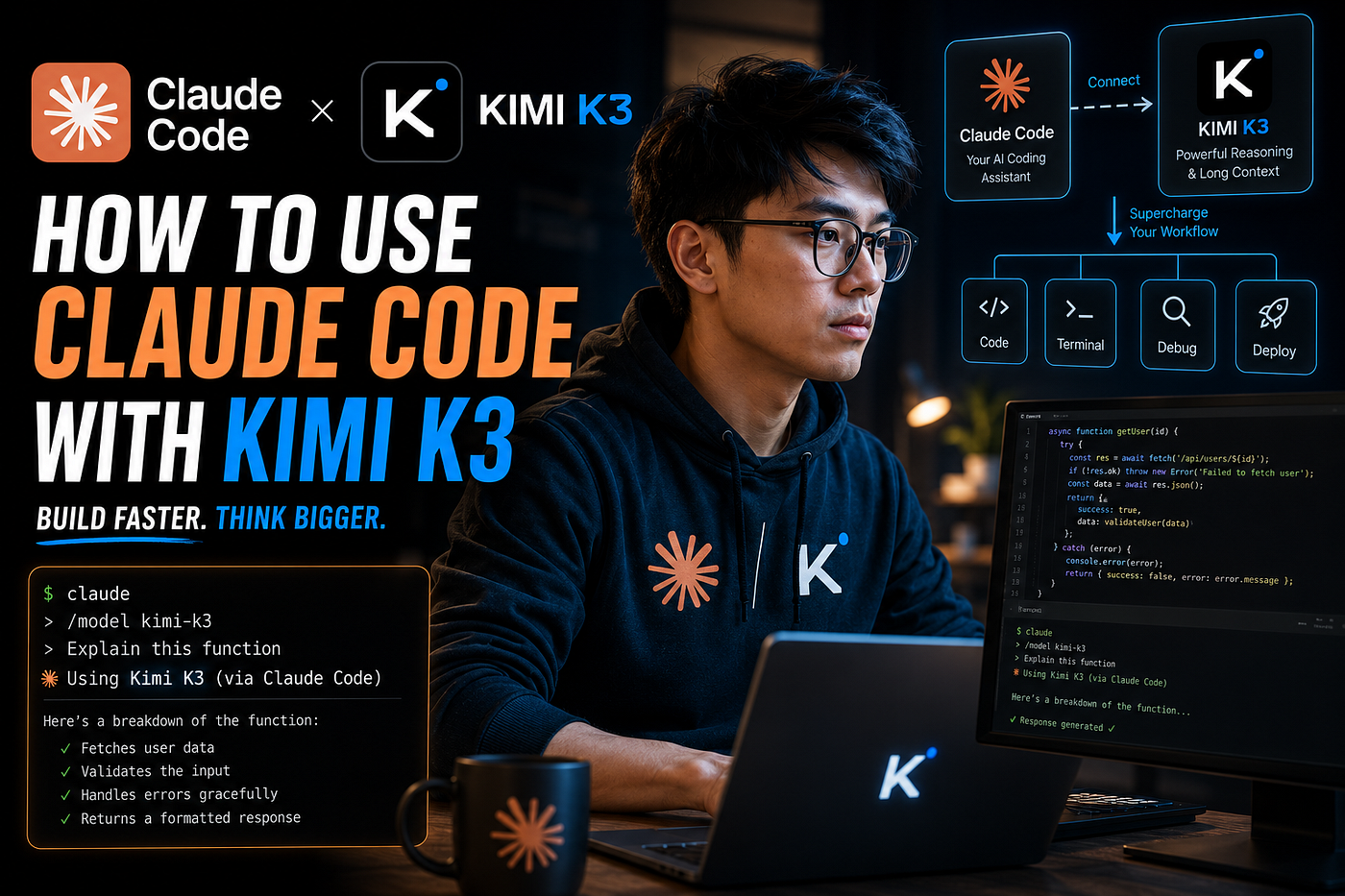
Kimi K3 vs. Claude Fable 5: 2026 Frontier Showdown
Claude Fable 5 (Anthropic) is the current top proprietary model, leading most aggregate benchmarks with exceptional reasoning, safety, and balanced performance. Kimi K3 (Moonshot AI, released July 16, 2026) is a 2.8T-parameter open-weight MoE model that narrows the gap significantly, often matching or beating Fable 5 in specific agentic and coding tasks while offering lower cost and openness.
Kimi K3 trails overall but delivers impressive value and leads in targeted areas, especially for developers and open ecosystems.
Key Specifications
- Parameters & Architecture:
- Kimi K3: 2.8 trillion total parameters (sparse MoE, 16 of 896 experts active). Features Kimi Delta Attention and Attention Residuals for efficient long-context handling.
- Claude Fable 5: Undisclosed size (frontier-scale, likely dense/hybrid with advanced reasoning optimizations). Emphasizes constitutional AI for safety and controllability.
- Context Window: Both ~1 million tokens (Kimi K3 at 1.048M). Excellent for long-horizon work.
- Modalities:
- Kimi K3: Native text + image + video.
- Claude Fable 5: Strong multimodal (vision) capabilities with high reliability.
- Availability:
- Kimi K3: API now; full open weights ~July 27, 2026.
- Claude Fable 5: API-only (proprietary, with enterprise safety features).
Performance and Benchmarks
Claude Fable 5 holds the overall lead, but the gap is small, and Kimi K3 wins several practical categories.
- Artificial Analysis Intelligence Index:
- Claude Fable 5: ~59–60 (top or near-top).
- Kimi K3: 57 (3rd/4th overall; strong for an open model).
- Agentic & Knowledge Work (Mixed results):
- Fable 5 leads on GDPval-AA v2 (1,760 Elo vs. Kimi’s 1,668), AA-Briefcase (higher Elo), and some broad agentic tasks.
- Kimi K3 wins or ties on Automation Bench, BrowseComp (91.2 vs. 88.0), Terminal-Bench 2.1 (88.3 vs. 84.6), and others. It ranks 2nd on AA-Briefcase overall.
- Coding & Software Engineering (Kimi K3 shines):
- Kimi K3 #1 on Arena.ai Frontend Code Arena (1,679 points, ahead of Fable 5; tops 6/7 domains). Strong on SWE Marathon (42.0 vs. 35.0) and Program Bench.
- Fable 5 leads on FrontierSWE and some DeepSWE variants; highly reliable in production coding.
Kimi K3 often beats or closely trails Fable 5 on agentic coding/long-horizon tasks but lags slightly on general intelligence, presentation quality, and some knowledge benchmarks. Real-world routing (using both) can achieve high combined performance.
Pricing and Efficiency
- Kimi K3: $3 input / $0.30 cached / $15 output per million tokens. Significantly cheaper.
- Claude Fable 5: Much higher (~$10–50 output range; premium pricing).
Kimi K3 offers better cost per task in many agentic scenarios (sometimes 2–3x more efficient value), though it may use more tokens/turns. Fable 5 is faster/more optimized in some deployments.
Strengths and Use Cases
Claude Fable 5 advantages:
- Highest overall capability and reliability.
- Superior safety, low hallucination, and judgment (enterprise-grade).
- Strong across broad intelligence, presentation, and complex reasoning.
Kimi K3 advantages:
- Excellent (sometimes leading) in frontend/agentic coding and specific long-horizon tasks.
- Multimodal native + open weights for customization/self-hosting.
- Dramatically better price/performance; accessible frontier capabilities.
Verdict
Claude Fable 5 remains the stronger overall model in mid-2026, particularly for general intelligence, safety-critical, or polished outputs. However, Kimi K3 is remarkably close—often superior in coding/agentic niches—and provides outstanding value as an open-weight option.
For many developers, researchers, or cost-sensitive teams, Kimi K3 (especially post-weights release) is the practical winner or strong complement. Test on your workflows: Kimi excels in sustained coding/visual/agent loops, while Fable 5 sets the ceiling for balanced, trustworthy performance. The rapid progress from Chinese open models like Kimi K3 is compressing the frontier gap.
Kimi K3 Agentic Coding Benchmarks: Strengths, Comparisons, and Implications (July 2026)
Kimi K3 stands out for agentic coding—tasks requiring sustained tool use, multi-step reasoning, repository navigation, terminal interaction, web browsing, and long-horizon project completion. Its 1M-token context, native vision, always-on reasoning (max effort at launch), and architectural innovations (Kimi Delta Attention + Attention Residuals) support these workloads effectively.
Key Agentic Coding Benchmarks
Here are the main ones where Kimi K3 shows strong results (often using "max" reasoning effort):
- Terminal-Bench 2.1: 88.3% — Near or tied for top (vs. GPT-5.6 Sol ~88.8%, Claude Fable 5 84.6%, Opus 4.8 84.6%). Tests command-line tool use, debugging, and system tasks.
- SWE Marathon: 42.0% — Strong lead (vs. Claude Opus 4.8 ~40.0, GPT-5.6 Sol 39.0, Fable 5 35.0). Measures sustained software engineering over long sessions with large codebases. Kimi K3 excels in endurance and iteration.
- Program Bench: 77.8% — Leads or ties top models (vs. GPT-5.6 Sol 77.6, Fable 5 76.8). General program construction and problem-solving.
- Frontend Code Arena (Arena.ai / LMArena): #1 with 1,679 Elo (ahead of Fable 5 ~1,631). Tops 6 of 7 domains (e.g., brand/marketing, data/analytics, consumer products). Blind human preference for generated interfaces.
- BrowseComp: 91.2% — Leads (vs. GPT-5.6 Sol 90.4, Fable 5 88.0). Agentic web research and information gathering.
- Automation Bench: 30.8% — Leads narrow (vs. GPT-5.6 Sol 29.7). SaaS workflow automation.
- FrontierSWE / DeepSWE: Trails leaders (81.2% vs. Fable 5 86.6 on FrontierSWE; 67.5 vs. 70–73 on DeepSWE). These test deep repo understanding and complex engineering.
- Other: Strong on SpreadsheetBench, OmniDocBench, and internal Kimi Code Bench. Artificial Analysis Coding Agent Index: ~57 (joint #5, ahead of Opus 4.8).
How Kimi K3 Performs in Context
Kimi K3 shines in long-horizon, iterative, and tool-heavy agentic workflows (e.g., terminal ops, sustained coding, frontend generation, browsing+automation). Its massive context and sparsity help maintain coherence over extended tasks.
It is competitive with (or beats) top closed models like Claude Fable 5 and GPT-5.6 Sol in several practical areas but trails on the absolute hardest repo-level tasks (DeepSWE/FrontierSWE). Independent tests (e.g., Artificial Analysis) broadly confirm vendor claims, with Kimi K3 ranking high among open models and in the frontier tier overall.
Cost Efficiency: Often 2–3x better value than Fable 5 or similar (e.g., ~$3–4 per task vs. higher for closed models), making it attractive for scaling agents.
Caveats: Some scores are vendor-reported (weights release enables more verification). It can be verbose (higher token use) and may have slightly elevated hallucination in some evals. Real-world results depend on scaffolding, tools, and prompting.
Why It Matters
Kimi K3 demonstrates that open-weight models can reach (or exceed) proprietary performance in key agentic coding niches, especially long-running and visual/terminal tasks. Its Frontend Code lead and SWE Marathon strength make it particularly relevant for developers building agents or UIs. Combined with openness and cost advantages, it accelerates experimentation and deployment in agentic systems.
For production, many teams route between Kimi K3 (for volume/specific strengths) and top closed models like Fable 5 (for peak reliability). As weights become available, community fine-tunes and optimizations will likely push its agentic capabilities further.
Kimi K3 doesn't dominate every benchmark but carves out a strong position in the agentic coding frontier, making it one of the most exciting releases of 2026 for practical AI engineering.

No comments:
Post a Comment